







FringeReview Scotland 2026
The Splitting of Latham
The Southside Group in association with The Occasion

Genre: Community Theatre, Disability Arts
Venue: Queen's Park Govanhill Parish Church
Festival: FringeReview Scotland
Low Down
At some point in the past, George Latham upset the scientific community with his experiments. Now exiled along with his wife, Fanny, but not their children, the wife has got in contact with them, John and Florence to whom she is sending a surprise package: the equipment that George had been using for his experiment and they can now use to complete it.
Review
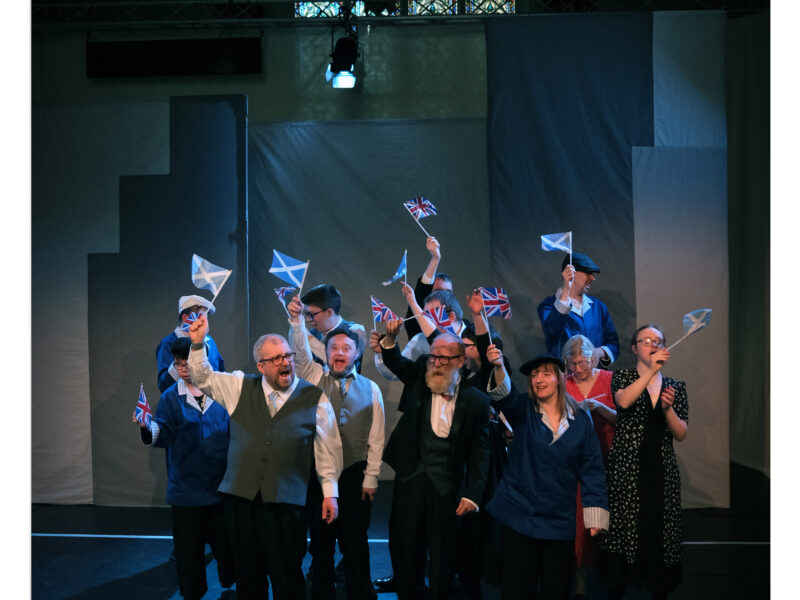
It is 1938 and at Bellahouston Park in Glasgow, the Empire exhibition is happening. John is going to try and complete his father’s experiment and resurrect the family name and their reputation. Lady Solace, chair of the scientific society, goes all in to fight them off from disgracing the reputation of the scientific society once again by dispatching her two henchmen, Dobson and Agnew. John secretly tries out the experiment once a chair with wires and a helmet is assembled which leads to his individual character traits become characters of their own – thus the splitting of Latham into amazement, irritability, hilarity, glee and confusion.
The Southside Group of Glasgow are an adult special needs theatre company who, every time I come to see them, surprise me even more with their ability to not only dramatise original theatre but also hold a performance.
There are, as you would imagine, different abilities on stage, but what is keen here is the way in which the Occasion Group have managed to ally those personalities to developed characters. Taking advantage of the abilities that arrive in rehearsal is a skill. Rather than disadvantaging people for what they cannot do, people are prized for their alternative abilities. It is inclusive because people are given roles and opportunities to be part of a greater good. Here that is augmented by a script that again uses an original storyline.
Michale Duke’s script tells a story that begins in the truth of 1938, Glasgow, the British Empire Exhibition in Bellahouston Park, which anchors it in something that allows the development of skills and abilities to be allied to people’s abilities and their creative growth.
There is no condescension here, these are people who have a craft. This time round it has become more theatrical by having surtitles and seeing the highly experienced theatrical BSL interpreter, Karen Forbes perform BSL duties showing that this is part now of a mainstream theatrical project.
Surtitles means you need to know your lines. And they bleeding do! I have seen approximations being peddled onstage with the script feeling more like a guide than the message we should hear regularly and having professional actors make something up that is an approximation of the author’s intention.
Inclusiveness was helped with the lights being fully up, the closeness of us to the stage and whilst of course there is an audience packed with supporters and families, it is a critical element of the experience.
And so, seeing Lily Payne as Lady Solace and the wonderful Disney-like henchman of Dobson and Agnew being Liam Robertson and Hughie McIntyre.
As Florence Linzi Finnigan manages to play off John Howell’s John Latham as a sceptical sister who works very hard to keep him in check – consistently and constantly failing to do so, which is to the delight of all of us.
The rest of the cast, Carole Beveridge, Karen Hosie, Dean Hay, Alice Beattie, Maria Stevenson, and as Amazement Calum Alexander, Irritability Jordan Doran, Hilarity Adam Sloan, Glee Monica Brannan, and Confusion Joseph Clancy provide the platform necessary to ensure that we all know what is happening, even in the chaos of seeing six versions of one person.
It was almost like an updated version of a morality play from medieval times where characters could not be real people but qualities. It shows this is a development of a tradition.
The set was mainly functional and when people disappeared behind it and we had the use of shadow it was effectively woven into the fabric of the performance.
Peter Clerke and Catherine Gillard as directors, have created stories embedded in the abilities of the participants. There shall have been ups and downs and drama within rehearsal rooms, but when the nod comes to start the show we get an ensemble piece of great quality.
The power of theatre is absolute, obvious, creative, inventive, delightful, worthwhile. It’s something to remind yourself that the reason that we get involved in theatre is because of its transformative power.
There are very few organisations, companies, or theatres which can demonstrate that more than the Southside Group.