







Brighton Festival 2026
Oh To Believe in Another World
Brighton Philharmonic Orchestra with William Kentridge

Venue: Brighton Dome Concert Hall
Festival: Brighton Festival
Low Down
Intriguing to watch and invigorating to hear, Oh To Believe in Another World is a chilling yet thrilling exploration of the Soviet attempt to build a Utopia.
“The central characters of the film are Lenin, Trotsky and Stalin; Shostakovich and his student Elmira Nazirova; the poet and playwright Mayakovsky and his lover Lily Brik. We still feel the emotional journey of the music, independent of its historical moorings, but at the same time acknowledge the particular character of the era from which it comes.” William Kentridge.
Director William Kentridge, Joanna MacGregor, Conductor and Music Director CEO of Brighton Philharmonic Orchestra,
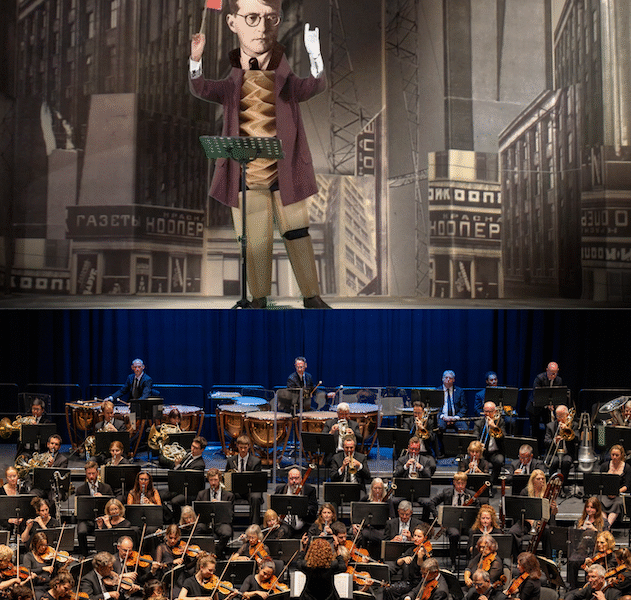
Photo courtesy of Kentridge Studio
Review
William Kentridge is a questing artist, always experimenting with techniques and materials, from his long-favoured and frequently animated charcoal drawings to model making, puppetry and performance. He’s designed music-theatre productions like Berg’s Lulu and several operas; this summer Glyndebourne presents his version of Monteverdi’s L’Orfeo, a hot ticket even by that opera house’s standards.
This though is his first film made for an orchestral score, commissioned by the Lucerne Symphony Orchestra and premiered there in 2022. So it’s quite a coup for Brighton Philharmonic Orchestra (BPO) to bring artist, film and orchestra together in Brighton. Shostakovich wrote this symphony, his tenth, in 1953, the year of Stalin’s death, which is what drew Kentridge to it. Always a political artist (his background as a South African of Jewish heritage living through the apartheid regime makes this somewhat inevitable) the impact of Stalin’s death on Russian artists drives the imagery on screen.
Kentridge’s approach is to provide a visual backdrop that complements the score with no attempt to interpret the music or give a linear narrative. Using a beguiling mix of puppets, sculpture, found footage and performance he instead brings a cast of characters to life. The film opens with images of revolutionary crowds in 1917, a bit like an Adam Curtis cut-up. Some faces are scribbled over or blanked out; an indication of what is to come. Then, like a key change, as the moderato builds, the viewer is guided through dilapidated rooms, walls separate, patterned floors rise up in what seems to be an abandoned museum. It’s like a journey round a stage maquette; there are glass vitrines in which objects come to life – a dancing figure fashioned from metal pliers and pleated cardboard skirt. A puppet Shostakovich conducts the orchestra with a little red flag. It’s a disarming mix of digital wizardry and old school craft.
Poet Vladimir Mayakovsky’s futurist lines flash on the screen “How To Improve the Construction of Man” and “March Faster!” as the figures of Trotsky, Lenin and Stalin circle round each other. The text is sometimes too fast to read and can distract; the fascinating phrases took me away from the music at times despite Joanna MacGregor’s vivid conducting and the lively and powerful orchestral playing in response.
Like a constructivist artwork brought to life, in muted colours with flashes of red, masked faces are held at tilting angles by performers who themselves look like animations. Paper and cardboard eventually crumple and fall – a full size human arm reaches in. This is all a fabrication and the world is getting darker; we witness images of lost lives as horns and timpani bring the piece to a defiant close.