









Almada Theatre Festival 2026
Danse Macabre
MZ Atelier
Genre: Circus, Clown, Dance and Movement Theatre, Experimental, Physical Comedy, Physical Theatre
Venue: Escola D. António da Costa, Almada - Palco Grande
Festival: Almada Theatre Festival
Low Down
Swiss choreographer and director Martin Zimmermann takes the audience on a visual and at times absurdist journey reminiscent of Federico Fellini’s “The Clowns,” where the marginalised characters of our society show us how life prevails over death, manifesting its cosmic power with pure, brutal, primitive and unfiltered energy.
Review
Danse Macabre, which opened the 43rd Almada Theatre Festival, is a show of striking visual impact created by Swiss choreographer Martin Zimmermann and interpreted by Tarek Halaby, Dimitri Jourde and Methinee Wongtrakoon and Zimmermann himself.
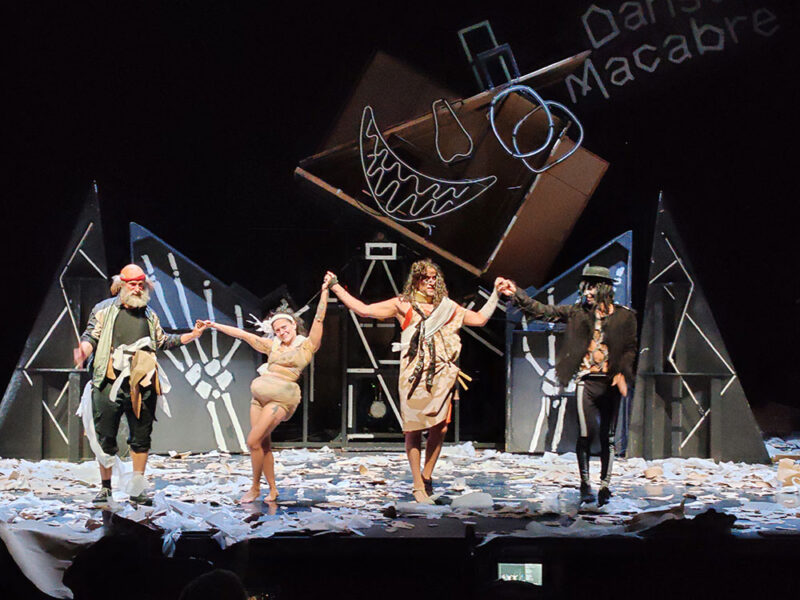
The story takes place inside a huge waste dump littered with carton paper, trash bags, and the many leftovers of an industrial consumerist society. A pyramid with an abandoned wardrobe overlooks the dump, towering over a dark, clownesque character of Death who moves around the dump, smacking his lips and mimicking the sharp chattering of a rat.
The living human inhabitants of this underworld are three characters: a Tramp, a Woman, a Transvestite. They emerge from the bowels of the wardrobe which sways violently, forcing them to struggle desperately to keep their balance in order not to fall into the wasteland below.
It is one of the many scenes, beautifully choreographed, where dance, nouveau cirque and clowning techniques are used to bring forward the story of these marginalised characters of society. Their life is a constant struggle for survival, and Death is always looming by, waiting to collect their human remains.
This contrast between life and death is also underlined by a scene where the Transvestite gives birth to a spongy wasteload on the stage. These fragile individuals, absurd as they are, are a testimony of how life prevails even in a context of absolute desolation.
They are involuntary clowns of a tragicomic world, reminiscent at times of the physically or socially alienated comic characters of Federico Fellini’s 1970 film “The Clowns.”
The Tramp in particular, is the Augusto who constantly messes up, fails to adapt to the rules of the Clown Bianco (Death), suffering endless slapstick misfortunes. Even the act of tying up a simple shoe becomes a 15-minute-long piece of impeccable clowning and acrobatic skills where the audience laughs at this seemingly cursed character.
However, thanks to this comedy we are able to accept the sinister reality of a world ruled by pure survival instinct and raw emotions. As Fellini said: “The clown is the shadow, the double, the mirror that reflects our own ridiculous and deformed image.”
In this perspective, what we see happening on the stage is a projection of our worst fears hidden in our unconscious. We are able to project our mental deformity onto these three characters who symbolically sacrifice themselves on the stage in order to free us from any sense of guilt.
The end result is an 80-minute-long show that is able to engage us emotionally and give us moments of pure joy that alternate with absurdist or darker scenes. All of this with a rhythm that is able to entertain us to the very end, while conveying a deeper poetic message on the power of life itself, even among the most forgotten places, and the forgotten souls of our society.