












Almada Theatre Festival 2026
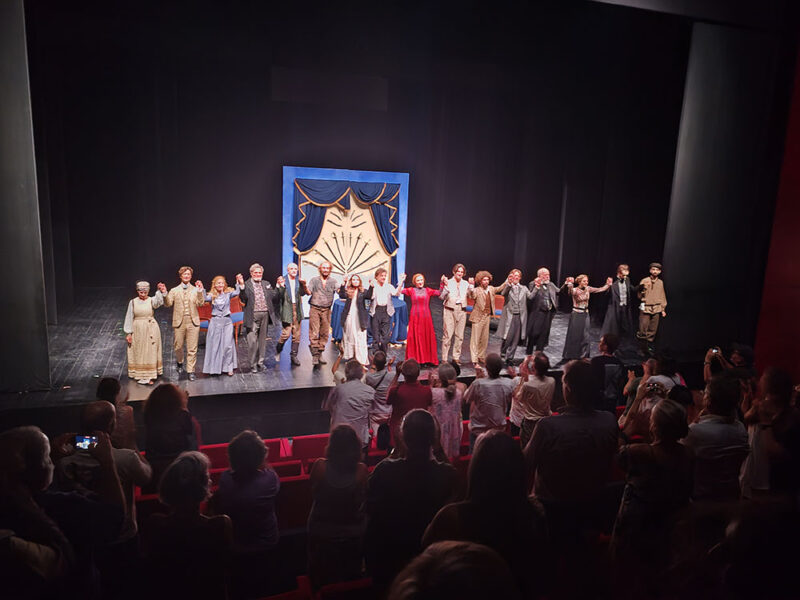
Platónov
TieffeTeatro – Teatro Menotti Milano

Genre: classical, Drama, International, Mainstream Theatre, Theatre
Venue: Joaquim Benite Municipal Theater
Festival: Almada Theatre Festival
Low Down
A daring five-hour-long mise en scène of a forgotten work by Anton Chekhov which gives life to a classical interpretation that is able to maintain momentum despite its length thanks to a solid professional cast and detailed stage direction.
Review
Produced by TieffeTeatro – Teatro Menotti Milano and under the supervision of German director Peter Stein, Platónov is a five-hour-long theatrical marathon which brings to life one of the earliest works by Anton Chekhov. Written when the Russian author was just 20 years old, Platónov was never staged in his lifetime and would probably have been forgotten had it not reappeared in 1923 as part of an obscure edition bearing the simple title “Unpublished play by A.P. Chekhov.”
The play is a carousel of Russian rural society, with at its centre the 35-year-old Platónov, who, although intelligent and gifted with a magnetic beauty, struggles to find his place in his world. He is a simple elementary school teacher living in an imaginary remote provincial Russian district known as Vojnicevka, far from the great urban centres of Moscow or Saint Petersburg. Within the isolation of this remote Russian enclave, boredom triggers intense passions. It is a decadent aristocratic society, strongly divided between the haves and have-nots, dominated by the craving for money and the existential void of the play’s protagonists.
While the first hour feels a little heavy, as the many characters and their purposes are still unclear to the audience, the play quickly takes off from there as Platónov becomes a prisoner of a web of passionate relationships with four different women. The tension between the pleasures of the flesh and his spiritual need to find a place in this apparently empty society leads him slowly into a process of self-destruction.
He is unable to fit in and feels guilty of turning his back on his wife Sasha, a young and naïve woman who deeply loves him. Acting as a catalyst of a dialectical narrative movement, her antithesis is one of Platónov’s lovers: Anna Petrovna. She is older, a wealthy widow, who hosts grand parties and tries to shake Platónov out of his spiritual anguish.
In the background, two other women, Sofya Yegorovna and Marya Grekova, complete the quartet of lovers whose attention towards Platónov only throws fuel onto the flames of his spiritual anguish.
It is a story that still resonates with a modern audience, although its content has certain peculiar Russian traits to it. The staging and interpretation remain very classical, and the main characters come across as vivid and “alive,” thanks to the impeccable performance of the actors, while some secondary characters blur at times into the background, as expected with a play involving such a large cast.
The scenography features a large, complex stage design with visible transitions (courtyard, house by the railway, mansion interior) requiring cast and crew to assemble environments live. It is a massive production that makes sense within the programming of a large festival such as the Almada Theatre Festival.
Despite its length and the fact that the play is delivered in Italian with Portuguese subtitles, everything holds together and this ambitious theatre work is certainly successful in giving us unforgettable moments of classical theatre — a once-in-a-lifetime experience that allows the audience time to slowly reflect and ponder on the archetypes of human fragility in a world of ever-increasing, rapid entertainment consumption. Overall, a very good moment of classical theatre that gives us scenes that remain with the spectator long after it is over.