






Thessaloniki Fringe Festival 2026
The Course of an Argument
Iro Vasalou
Genre: Dance, Dance and Movement Theatre, Experimental, Physical Theatre
Venue: Transcendance
Festival: Thessaloniki Fringe Festival
Low Down
Iro Vasalou has created an experimental dance-theatre piece that takes the audience on an original journey through the emotional turbulence of an argument. Although still a little sketchy in its set-up, it has a magnetic quality and the potential to grow into a solid piece of work.
Review
Performed by Greek dancer and choreographer Iro Vasalou, The Course of an Argument is an original performance mixing elements of dance-theatre and leaning towards the experimental, without ever crossing the line into the hermetic or the hard to understand.
The dramaturgical core that holds the different pieces of this performance together is the act of arguing. We don’t know whether the argument is a romantic one or rather an exploration of arguing per se, although we are led to believe that the push and pull embodied in Iro Vasalou’s dance sections is closely related to the deep emotional conflict that arises between two people who share a profound bond, such as lovers or family members.
The first 20 minutes of the performance entertain and hold the audience’s attention, thanks to an original staging with an almost unconscious magnetic quality. The visual impact could be the stuff of cinema, straight out of a Fellini or Pedro Almodóvar film.
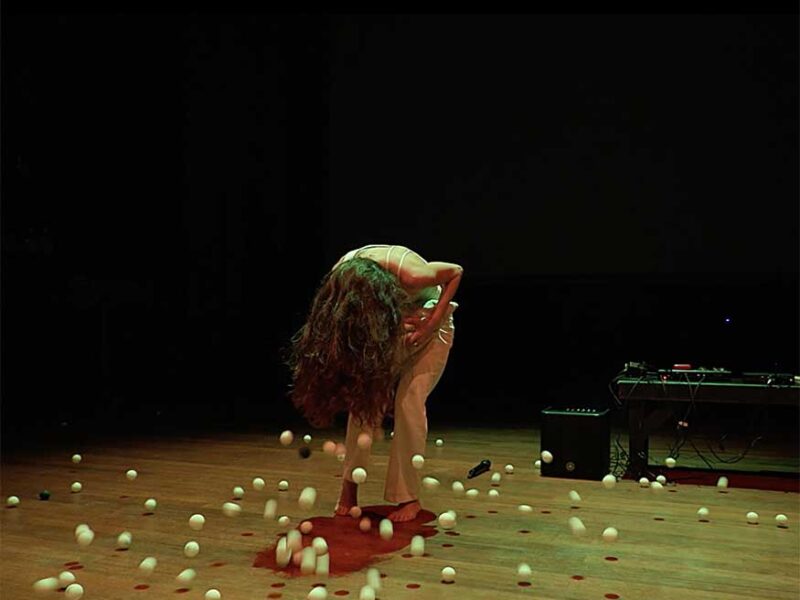
The performer is immersed in a white setting and wears a white costume consisting of a simple skirt and top. The elements of timing, play and genre are clearly established. The dancer begins playing with table-tennis balls whose sound is fed into a loop machine. What follows is an ingenious choreography that explores the inner emotional turmoil of both parties in an argument, as the dancer moves swiftly between the roles of attacker and victim.
This is never done in a shallow or stereotyped way, through screaming or random bursts of energetic movement, but in a delicate, more introverted manner that lends a certain finesse to the whole experience. At one point the audience is invited to throw onto the stage a set of pink plastic balls on which they have written (as invited to before the start) a sentence they remember from an argument they took part in.
At this point, though, the performance tends to lose its raw and mysterious power. The act of opening the plastic balls breaks the rhythm of what had been a carefully choreographed carousel, and an excessive use of loops throws cold water on the fire Iro Vasalou had managed to light.
Yet the imagery evoked is powerful. The expression “walking on eggshells”, which describes the experience of dealing with a highly irritable partner, is physically recreated in the choreography. A piano breaks the monotonous rhythm of the loop machine. There is definitely interesting material here.
This is the build-up to something that could travel much further. The yang is there; what is missing is the yin. After all, intense hate can only come from intense love, and vice versa. Arguing is the manifestation of deeper, lurking emotions: fear of abandonment, low self-esteem, the need for validation. Arguing can serve a purpose. Arguing can even kindle desire.
There is a lot to be explored from this perspective.
The seeds are there, and Iro Vasalou has the stage presence to let this tree grow stronger.