
FringeReview editor-in-chief Paul Levy interviews queer activist Noah Alfred Pantano about his controversial, provocative, and multi-award-winning comedy (of sorts). “Pup Play: A Queer Pseudo-Lecture (of sorts)” follows Professor Handler David as he teaches the audience about the kink of pup play. The show has won multiple awards and raised over £1000+ for LGBTQ+ charities worldwide. The show is on at the Baron’s Court Theatre from July 16-18 before touring to Colchester Fringe, Stockholm Fringe (and more to be announced).
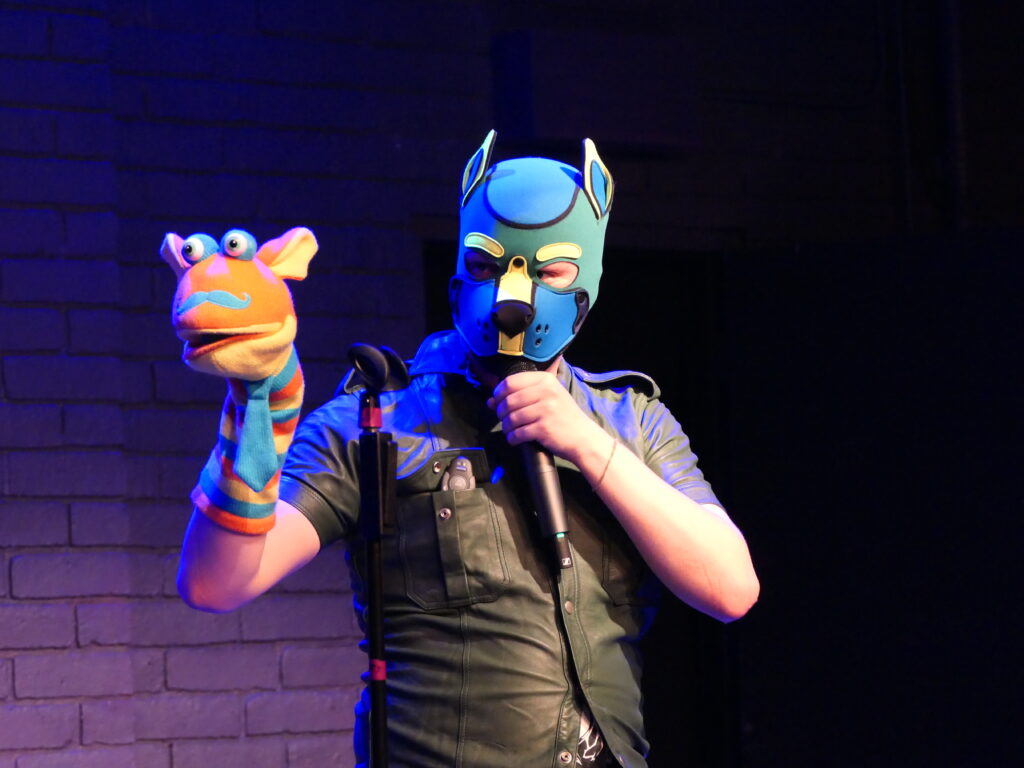
PL: The show is at Barons Court Theatre, a small subterranean pub theatre in West Kensington. How does that space shape the intimacy, tension, or mischief of the piece?
NAP: Pup Play relies on that direct line of contact between me and those watching. It is a playful yet confrontational show and Baron’s Court lends itself well to that dynamic. There is no fourth wall. In too large a space, I would lose moments of closeness and intimacy that the show relies on. Pup Play demands to be seen. And thus, the closer the audience is to me, the only option is to look. It is hard to deny someone’s humanity when they are this close to you.
PL: The title is funny, but the show also feels academically loaded. Your show frames pup play as a “queer pseudo-lecture.” What does that format let you say about kink and queer culture that a normal documentary or club-night piece wouldn’t? How did you decide where to draw the line between satire, theory, and actual sex education?
NAP: The surtitle “A Queer Pseudo-Lecture (of sorts)” often is a source of discussion and disagreement about the show. One critic for Everything Theatre marked Pup Play down in their review last year seemingly because of it. They said: “Throughout the entire production, Pantano hides nothing from his audience, going to great lengths of vulnerability to get his message across, with that message being one of activism, and taking a stand for the queer cause… Yet, it is unclear why the production is titled a ‘Pseudo-Lecture’ as pseudo implies that something is artificial, and there is nothing artificial about this message.”
Yet, what I think this reviewer did not understand is that “pseudo” does not refer to what is being taught but how it is taught. Pup Play is not a lecture in the traditional sense. It masquerades as one to gain the audience’s trust just enough to subvert and surprise them later on. Moreso, and maybe most importantly, lectures are the transference of knowledge from an authority (me) to an audience (you). Yet, this queer pseudo-lecture is ultimately not for you.
This format, a fake lecture, allows me to critique how we learn about queerness. The show, in actuality, is an amorphous form of autotheory which can become a punk show, club-night, lecture, documentary, children’s TV nightmare, or memoir at any moment. It is educational, with plenty of fun facts, but it is also educational in the interpersonal sense of knowledge. At times, it is unclear if the show is even about pup play anymore, or something much bigger. Ultimately, at best, you can only ever describe my work through the queer frame “(of sorts)”. The only thing you can say for certain is that it is never boring.
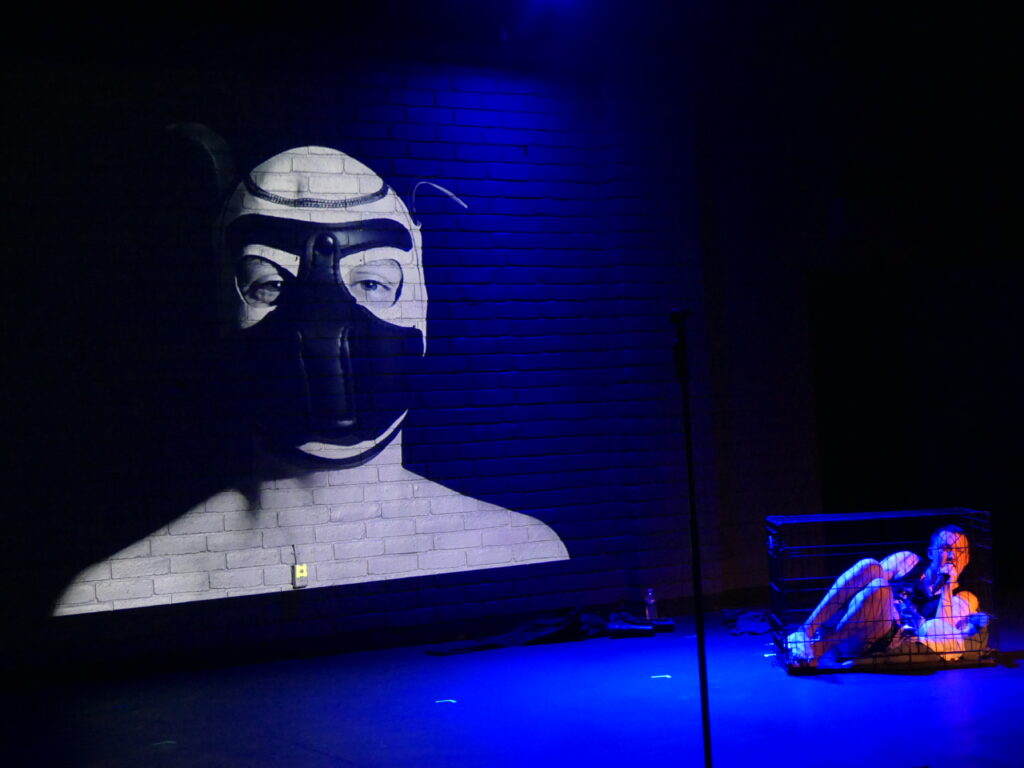
PL: There’s a line in the premise about “submissive puppy headspace,” which is very specific. How do you dramatize an internal state like that without turning it into caricature?
NAP: The puppy headspace is a state of instinct. It is the point, as David describes, where the pup thinks only about being a pup and worries about nothing else. They react simply on playful instinct. The show is dramatizing the steps to do so through its five-part structure: YES, EYES, LANGUAGE, PITCH, and SENSATION. That structure is how the show avoids caricature. We are not viewing a character enter puppy headspace. Professor Handler David guides himself and the audience into it through the course of the show.
PL: You’ve got multimedia projections, puppets, and erotic musical numbers all in one piece. What was the first element you knew had to be in the show, and what changed most during development?
NAP: The music was always a key part of the show. In even the earliest drafts, there was space for these songs written by Jacob Sullivan, a punk artist based in New York City. I told Sullivan the themes of the sections and left the rest to him. He wrote me two incredible songs. Honestly, they make me choke up with emotion every time I sing them. They have been relatively untouched through hundreds of drafts and edits. The music is my thematic bridge between sections and underscores the intense emotions Pup Play explores. As they say, when the emotion gets too much: SING. Alan Xtra and Tungsten Lungs wrote additional music for the show as well which underscore key emotional beats.
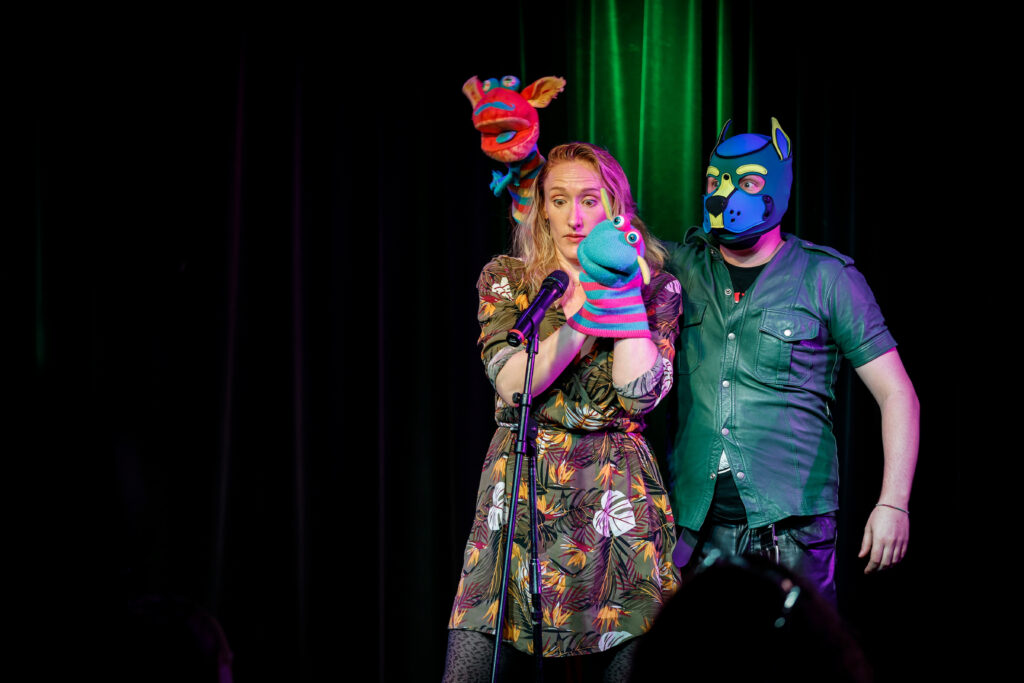
PL: The description mentions audience participation. What are you asking the audience to do, and how do you keep it playful instead of feeling like a gimmick?
NAP: I do not want to give too much away, but most of the participation is quite simple. The act of raising hands, asking questions, barking, and looking at your neighbors. There is, of course, some more fun stuff like double fisting of puppets, but only one lucky person gets to do that each night.
The participation is always framed around complicity with what’s happening. Pup Play consistently draws attention to the fact that you are present in this space with me. And that’s why I believe the participation never feels gimmicky. The participation makes you decide, quite bluntly, to be queer or continue to do nothing. There is always a point to be had. The participation keeps the audience engaging critically with what is happening and helps them avoid falling into the allure of performance. The extreme variance in response (the shouting, walkouts, and audience members arguing amongst themselves) proves to me the effectiveness of the provocations in the show. The show is trying to keep the barriers between performer and audience minimal. And because of that, I am often terrified before each performance because I truly do not know what will happen at that performance. The audience always surprises me, usually for the better.
PL: When you’re writing about pup play for an audience that may not know the subculture, how do you avoid making it either just a joke or a dry fetish explainer?
NAP: You prioritize the human experience. Pup Play critiques how we teach and explain kinky subcultures.
The show opens with David barking nonsense at the audience. That is because the opening gives the audience exactly what they expect of David: for him to be a dumb dog with nothing of importance to say. The audience comes into the show expecting to be shocked by pornography and sex stories. So the first part gives them just that to lower their guard. Professor Handler David does make jokes and dryly explains what pup play is. In a few instances, he outright makes stuff up to seem more credible and knowledgeable. Yet, because he is a professor, nobody questions this.
The first section purposefully fails to explain why pup play (or David) matters. Why would anyone engage in such a strange community? Lectures too often pathologize emotional and unusual queer experiences. The lecturers themselves are rarely scrutinized.
Over the course of the show, the priority shifts from pup play as an academic concept to David’s experience with it. It focuses on memory, space, and inexplicable moments of queer hope and dread. The lecture format is discarded altogether in favor of something less clear-cut. It reframes what should be taught, how it is taught, and prioritizes internalized community-based knowledge. David, I suppose, becomes a facilitator of the conversation around pup play, not an authority. By the end, pup play is not a concept to be taught but an embodied lived experience.
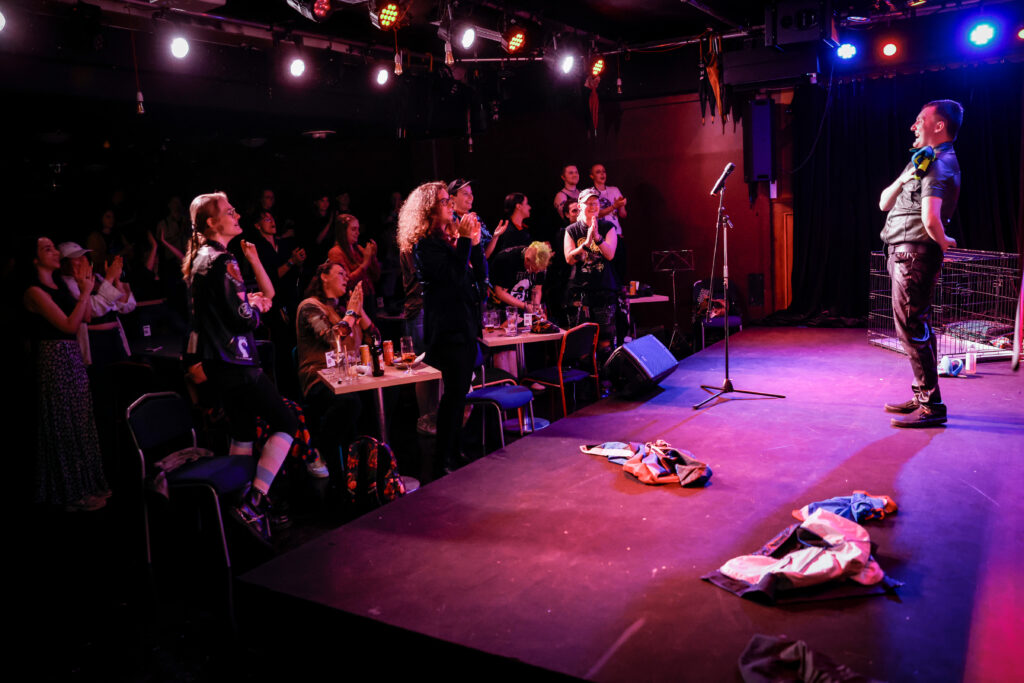
PL: The material sounds deliberately provocative. What reaction are you most hoping for from the audience: laughter, discomfort, recognition, or something else?
NAP: Pup Play has faced or been censored in nearly every theatre or fringe festival it has taken part of around the world. No matter where I go, the show is political. In fact, Baron’s Court Theatre is one of the few places where the show is performed in its uncensored entirety. That’s thanks to Leo and the rest of the amazing Baron’s Court Theatre team.
The censorship is not because of the content of the show but because queer sexuality is provocative. Most of the bigotry I have received has been based on what people assume the show to be. The idea of gay sex often disgusts people. They believe all discussion of it must be pornographic. If I wear my leather uniform at Pride, people whisper that I am forcing my kink onto people. The mere sight of a pup hood has caused me to receive death threats. My posters are too often defaced and torn down. Pup Play faces more scrutiny than most other fringe shows because it is about queer sexuality, and it is often serious in tone. Bigots have warned me not to do my show or else I “may just end up dead.” One fringe assumed that because the show has audience participation AND talks about gay sex, that THEREFORE means I will have live sex with the audience. Even after reading the script, “just to be sure,” and realizing this was not at all the case, they still made the whole audience sign consent forms and sign away liability to watch the performance “just to be safe.” Other theatres likewise assume no audience would come see my show because it is far too shocking (aka gay). As one theatre said, despite the awards and critical acclaim, “from a business perspective, we don’t think we could sell it.” Pup Play often packs out theatres and defies that perspective on queer work in doing so.
Like most other pups, these theatres, fringes, and audiences deem me to lack value and to see me for who I am. Because if they were to look at me, to program me in their theatre, or to see my show, they would have to face the fact that they cannot stand my identity. That many of them are deeply prejudiced against queerness. That they’d much rather I be silent and locked in a kennel in a dark room.
That is the overwhelming irony of the show. The show is only shocking to the uninitiated. Every pup who has come to my show has expressed joy in being seen, heard, and represented. They are not shocked because the show is an honest portrayal of who we are. The only people who leave my show shocked are those who entered with prejudice. Pup Play is only provocative because my existence is provocative, because being queer is dangerous, and because being loud and queer can be a death sentence.
And that’s what I want the audience to recognize. I want them, through discomfort, anger, and humor, to recognize that we are all complicit in violence and prejudice against queer people. But likewise, we all have the power to do something about that. This show is my way.
Pup Play is on at the Baron’s Court Theatre from July 16-18.
It is then on at Colchester Fringe Summer Weekender July 24 & 26 and Stockholm Fringe August 27-30. For more information on future performances, please follow @pantsoffproductions on Instagram and Facebook or visit pantsoff.org.