









Why Butoh? Why Now?
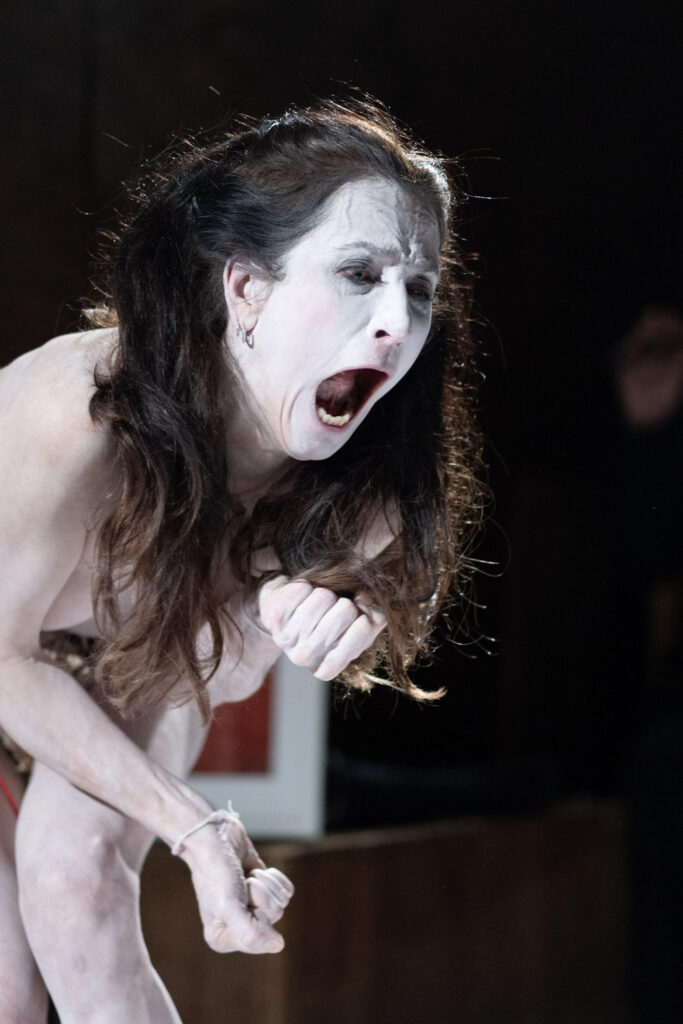
Paul Levy from FringeReview interviewed Joanna Rosenfeld, performer and Butoh practitioner during week zero of the Edinburgh Fringe 2026.
Joanna Rosenfeld’s blog…
As I watch my students slowly letting go of expressions of conditioning, of keeping others comfortable and themselves locked in; as I watch an emergence of something other, something true, something fresh and deeply moving; as we work with the land, encountering it through our senses, our touch, taking time not merely to move through it, but to be with it, clasping the nettle or the holly, letting ourselves be touched, stung, pricked, dirtied, hidden, affected, and in this closer encounter softened and changed, I think:
Maybe this is it.
Maybe my hunger, my compulsion, my absolute change in direction as a performer is connected to this.
Maybe what I always longed for was total theatre. A performance methodology that was so absolute it included all the layers of what I consider my humanity. My physical form, my body, my skills, my aesthetics, my visual sensitivity, my thinking and feeling, and even this nebulous thing that feels separate from all of these but experiences awe and reverence and deep gratitude.
An art form that allows for both the microorganism of human life and the macroorganism of the universe to coexist in consciousness. That allows me to zoom in and out of my experience simultaneously, while also moving me, shaking me, shaking my core and rattling the status quo.
When I scroll through my admittedly very curated Instagram feed, I keep being invited to mass tension-release events.
The videos show huge halls of people on mats with headphones and eye masks, crying, convulsing, while some—very few—men with microphone sets and slogans on their T-shirts appear to be tending the most distressed-looking individuals.
It says: 100,000 positive responses.
It promises Edinburgh, London, Leeds.
I also get ads for candlelit concerts in Linlithgow, so don’t get me wrong.
But why am I writing about this?
I guess I see these images because the crying people look like Butoh dancers. Their faces mirror the expressions in some of my posts. Their convulsions, their releases, mirror my own dance, and the algorithm can detect the similarity.
And then there is a cultural appetite for release. For a letting go of the over-curated, highly tended individual persona we have created.
And we are desperate.
We are sick and tired of being compliant.
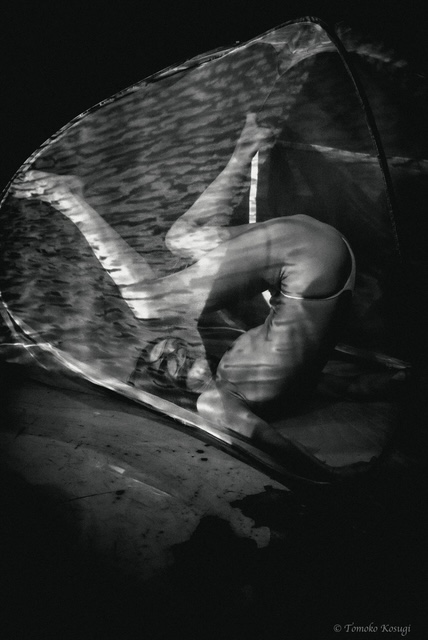
We experienced a taste of being managed and manipulated in the most inhumane and blatant way during the lockdowns. Something in us broke. Something in me was so stirred up that I could not let go of it again.
I am pretty sure my most difficult emotions to accept and experience or voice are vengefulness, hate, jealousy, envy and greed.
They are so difficult they belong to the seven deadly sins. We have collectively developed manuals to manage or suppress them for millennia.
The rubber band on my wrist did not stop my rage when I could not attend my friend’s funeral in 2020.
It did not stop my grief through the years of being locked away, teaching online, going insane, while dust danced in sunlight and the days disappeared inside a room, inside a house.
I still feel sick a lot when I look around me.
The eminent German painter Max Liebermann is reported to have said:
Ich kann gar nicht so viel fressen, wie ich kotzen möchte.
I cannot eat as much as I would like to vomit.
I feel that sentence a lot.
Maybe this is the core of Butoh.
Maybe what he said is Butoh.
How to see. How not to look away. How to truly see and continue to look, and then show.
To stay with it.
To stay with it even when it risks something.
To stay with it because it makes us feel more alive.
To stay with it because it shows the thin veil of civilisation.
Butoh does not change what I see.
It does not take it away.
But it gives me a space to work with it.
People had been telling me to look at Butoh for almost twenty years.
Every time I encountered it, I experienced a visceral response. Sometimes even disgust. I closed the book. I looked away.
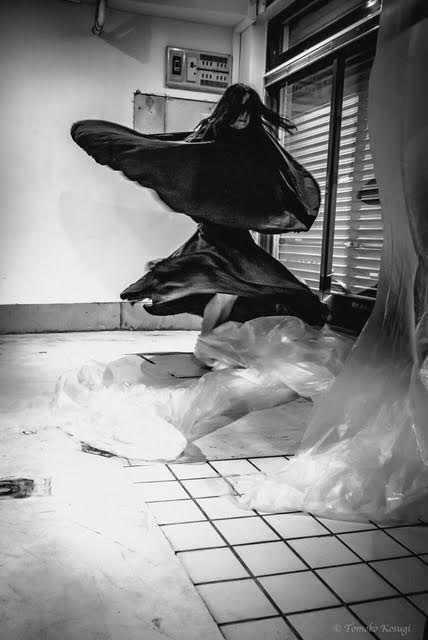
Eventually I stopped looking away.
Two years ago I travelled to Japan to study with teachers whose work had stayed with me long after I had tried to forget it.
I did not find answers.
I found a practice that continues to ask better questions.
And here is my why Butoh.
Because Butoh, to me, is total theatre.
It is an art form that has been and has stayed too radical for commodification. It continues to unsettle, subvert, confront, transform and challenge cultural norms of beauty, decency, sexuality, gender, identity, expression, age and mortality.
I could go on.
All while not turning into one way.
Butoh is as varied as there are grains of sand on the beach.
Butoh teachers are as varied as creatures from different planets.
There is no uniform style, method or outcome.
And yet it has the power to move me again and again.
As humans we do not just want to live and disappear.
We want to do something for each other.
We want to stay in community.
Maybe that is why Butoh creates communities.
It creates belonging.
It creates audiences that love each other.
It creates performers and workshop participants who love each other.
Maybe the time is right for Butoh.
Maybe the time is ripe.
It certainly is for me.
So I make Butoh in the Free Fringe.
Not because I want to be picked up and taken to the West End.
But because I have to.
If you dare, come.
Joanna Rosenfeld performs in ‘Resonant void’ as part of the Edinburgh Fringe Festival and the PBH Fringe. Book here
Venue: Diggers Leith – Upstairs Room (Venue 141)
Dates: 8–30 August 2026
Time: 14:30 daily
Running time: 55 minutes
Admission: Free (first come, first served) – donations are welcome