









Almada Theatre Festival 2026
Ansioliticamente Falando
Razões Pessoais

Genre: Comedy, Contemporary, Theatre
Venue: Auditório Osvaldo Azinheira
Festival: Almada Theatre Festival
Low Down
Raquel Castro writes an autobiographical mise-en-scène of her own anxieties projected onto Anton Chekhov’s The Seagull which, although stemming from personal experience, embraces the larger subject of the state of mental health in Portuguese society. A universal story that could easily be staged in another language such as French, Italian, or Spanish.
Review
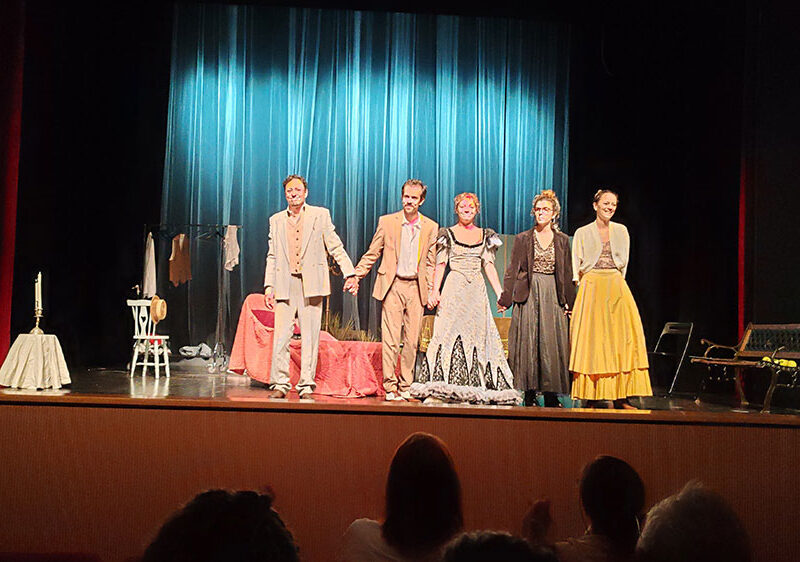
Five actors meet around a table to prepare the mise-en-scène of Anton Chekhov’s The Seagull. This simple premise is the start of what is a light comedy that hides inside it the larger theme of anxiety.
The company director (interpreted by Raquel Castro) explains to the group what the play is about and her vision for its staging. Everything is well planned: the rehearsal space is already hired, the premiere date is set, there are even plans for a tour.
However, as the story unfolds, each member of the cast reveals, in between the scenes being rehearsed, their personal insecurities and fragilities that keep them at a constant level of anxiety. The opportunity to open up is the coffee break in the green room of the rehearsal space, which is built off stage, within the stalls area of the audience, so as to reinforce the moment of intimacy which each character shares with us.
There is the actor obsessed with natural disasters and the fact that a meteorite could crash into planet Earth at any moment (interpreted by Pedro Baptista); his colleague, who is terrified of improvising on stage and must carefully pre-plan the journey from his home to the rehearsal space (interpreted by Paulo Pinto); the young actress who lives in a cramped Lisbon apartment infested by cockroaches due to an ever-present water leak (interpreted by Joana Bernardo, who, although the youngest of the group, delivers an impeccable performance). The only person who keeps her skeleton in the closet is the production assistant (interpreted by Sara Inês Gigante). For it is anxiety itself that binds these people together — an anxiety that they all project into the play by Chekhov they have to stage, and which is contained by the daily use of antidepressants and medications.
It is a theme that resonates with the condition of today’s Portuguese society, which sees one of the highest recorded rates of anxiety and psychotropic drug consumption in Europe (something even unknown to the writer before watching this play).
As heavy as this topic may seem, everything is brought forward with a touch of wit and good narrative rhythm, as each personal fragility is exposed in moments of enjoyable situational comedy. These are not hopeless characters but rather members of a larger society that shares a common vulnerability.
Overall, they are positive figures, trying to get out of their bind through finding a common purpose: theatre. From this perspective, the communal act of theatre per se becomes a curative palliative. Their daily effort in giving life to Chekhov’s creation builds a microcosm where they open up to the point where Chekhov’s characters blend with their own persona, blurring the line between character interpretation and real life. It’s a display of a psychological carousel of matryoshka dolls that keeps the audience entertained and never leans towards negativity, but rather keeps them in increasing tension towards a resolution.
It would have been easy for Raquel Castro to take centre stage immediately when writing this play. However, the distribution of focus in the narration is evenly shared between the characters, who really appear as a cohesive group united by the higher purpose of bringing Chekhov to the stage.
She truly gains narrative focus only in the final section of this play, which cannot be revealed for obvious reasons.
It is a universal story, and if it were not for the word “Lisbon” mentioned a couple of times, this play could easily be staged in another language such as French, Italian, or Spanish.
At times it even feels like material that could work off the stage, reminiscent in a distant way of film works such as Birdman but with a more evident Mediterranean flavour.