












Almada Theatre Festival 2026
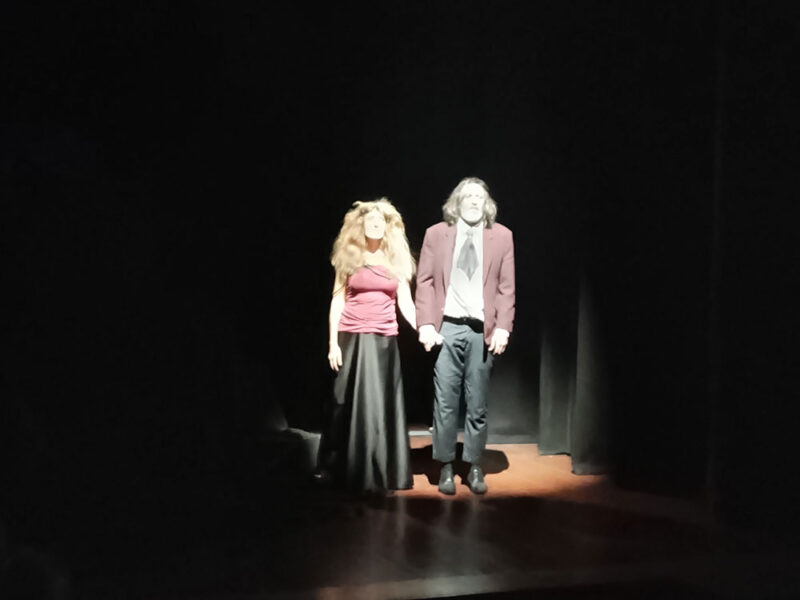
Happy Days
Teatro Meridional

Genre: Absurd Theatre, Drama, European Theatre, International, Theatre
Venue: Fórum Municipal Romeu Correia, Almada
Festival: Almada Theatre Festival
Low Down
Company Teatro Meridional takes to the stage one of Samuel Beckett’s masterpieces. The combination of an intense performance by actress Mónica Garnel and strong and effective light and staging is able to hold the audience in what is one of the hardest acting challenges for a female actor.
Review
Performed in the Fórum Municipal Romeu Correia of Almada, Happy Days opens on the stage with a set-up and light design that, although apparently simple, is able to hold the attention of the audience immediately with its strong visual impact. The character of Winnie, interpreted by Mónica Garnel, finds herself towering above the audience, immersed to the waist on the top of a surreal pyramid of black cloth and charcoal.
The darkness of the set-up contrasts with the red of a simple top she wears and the reddish colour of her hair. This red/black patchwork is highlighted both by a couple of spotlights that focus the attention of the audience on the protagonist and by a subtle red light backdrop that creates an imperceptible aura around her body.
The result is a surreal setting which could represent a ring of a Dantescan inferno, a deformed canvas by Salvador Dali or simply the duality of life and death. This chromatic tension mirrors the existential tension of the protagonist. Winnie’s only company is a bag lying next to her and her husband: Willie. He spends his time hidden beyond the dune of cloth and charcoal, only briefly appearing at times during the play, while reading a newspaper, his back to the audience.
Any attempt by Winnie to establish a contact with her husband is met by grunts and throaty sounds on his part, creating a picture of social isolation and alienation. Yet, no matter how hostile her surroundings are, and how claustrophobic and physically impairing her situation is, Winnie is, at least on the surface, an incurable optimist. She wears the mask of a happy person, always maintaining a forced smile, trying to see happiness in what appears a rather hopeless situation.
She has an attitude of seeing the world with the eyes of a child, fascinated by each item she pulls out from her bag: a toothbrush, a comb, a brush, a bottle of medicine and finally a pistol.
This last item becomes, symbolically, the means that could put an end to her apparently meaningless existence, although the idea of suicide is never openly contemplated in the play.
The monumental task of maintaining the psychological authenticity of Winnie’s character becomes even harder in the second act of the play, which opens with Winnie now immersed up to her neck into the black mass of cloth and charcoal.
Yet, Mónica Garnel is able to deliver such an intense performance to hold the suspension of disbelief in the audience, with only occasional moments of flatness that, however, appear almost necessary in order not to fall into an overacting that would transform the character of Winnie into a flat bi-dimensional caricature.
The result is an interpretation able to create emotional movement despite the condition of total physical impediment in what could be one of the hardest roles to play for a female actor and well worth watching.