









Almada Theatre Festival 2026
Saudações
Companhia de Teatro de Almada
Genre: Absurd Theatre, Comedy, Contemporary, Dark Comedy, European Theatre, Theatre
Venue: Teatro Municipal Joaquim Benite
Festival: Almada Theatre Festival
Low Down
Companhia de Teatro de Almada brings to the stage a collection of 3 short pieces by Eugène Ionesco that show how the Romanian-French playwright’s surreal stories have eerily turned into hyperrealistic snapshots of today’s normalization of insanity.
Review
“For me, comedy is a form of tragedy. It is the opposite of tragedy but tragedy itself at the same time. Comedy is more tragic than tragedy. Tragedy has rules… but comedy has no laws you can follow.” (Eugène Ionesco interviewed by Judith Jasmin in 1961)
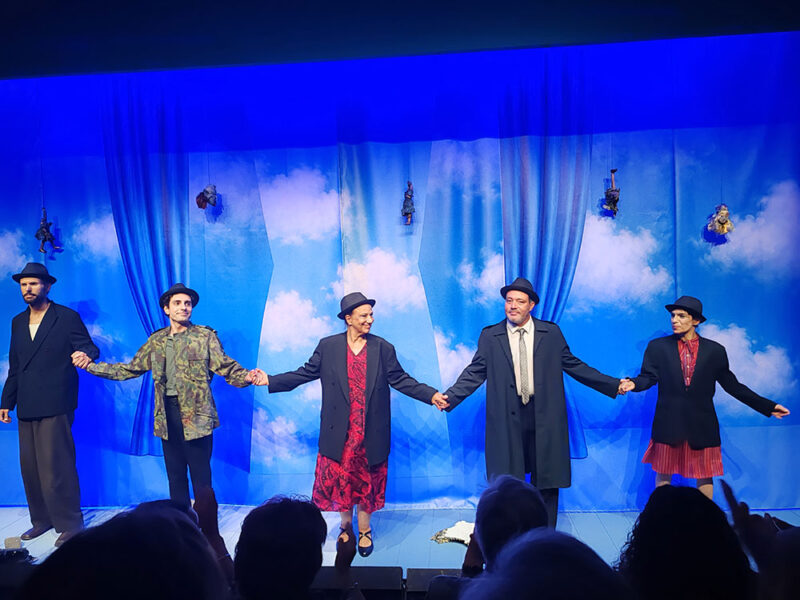
Companhia de Teatro de Almada, under the direction of Álvaro Correia, brings to the stage three absurdist short plays by Ionesco — Greetings, The New Tenant and Delirium for Two — performed by actors André Pardal, Bruno Soares Nogueira, Carla Bolito, Pedro Walter and Teresa Gafeira.
Greetings (in Portuguese Saudações) opens the performance. Three presenters welcome the audience and start an absurdist loop of greetings starting from the simple question “How are you?” This short sketch later helps to transition into The New Tenant and Delirium for Two, which constitute the main narrative blocks of this Ionescan collage.
In The New Tenant, a Tenant arrives in an empty apartment dismissing the chat of a talkative concierge, while arranging an endless flow of furniture. His material possessions slowly flood the stage to the point where he finds himself imprisoned inside a folding screen, shielding him from the outside world.
In Delirium for Two, an unnamed couple loudly argues over whether a snail and a turtle belong to the same species while a war rages outside their apartment. While screaming at each other, the two of them are almost dismissive of the explosions and the occasional exchanges of gunfire that they can hear outside. War is trivialised, becoming the background of a domestic fight which each of the two parties is intent on winning no matter what. The dead bodies piling up on the street outside become a motive of fleeting entertainment, and the fear of being involved in the conflict only becomes real when the couple hear soldiers walking up and down the staircase of their apartment block.
Even a grenade falling into their living room becomes a momentary nuisance that interrupts their discussion, to be carelessly thrown outside their window in order to continue talking about much more important worldly matters.
The directorial choice of putting these two pieces together on the stage works, as they expose from the narrative point of view, two different worlds that can be summarised as introvert and extrovert. In The New Tenant the protagonist is totally alien to what is happening outside and his relationship with the characters that surround him is cold and business-like, with no empathy whatsoever. In Delirium for Two the two lovers weaponise every word they use against each other to win their argument, in a toxic relationship where fighting becomes an existential purpose, both outside and inside their apartment.
The acting is sober, authentic, energetic and the text adheres to the original version.
However, both works feel so modern, compared to the times when Ionesco wrote them (1953 to 1962), that rather than surreal they appear today as eerily hyperreal.
This is because both of them touch themes that have now become so familiar as to normalise their absurdist intent of the times.
The social isolation evoked in The New Tenant can be seen as a metaphor for today’s virtual isolation. One wonders what conversations or stories Ionesco would have created when seeing how pretty much everybody nowadays is immersed in their portable devices. In this perspective, the folding screen within which the New Tenant finds himself imprisoned can be seen as a symbol for the mobile phone screen, which shields us from the uncomfortable experience of talking to strangers in public places, or holding a real conversation with a person.
In particular, in an era where a global pandemic has been followed by a constant stream of wars which may eventually lead to nuclear exchanges or global catastrophe, Delirium for Two really evokes how we have normalised insanity in today’s world.
In this context, Saudações leaves the spectator with the uncomfortable feeling that present reality has now surpassed past fantasy, and acts as a living testimony of the absurdist visionary power of Ionesco’s work.
The more it ages, the more modern it becomes.