

Brighton Fringe 2026
The Covetousness
Jingkun Chinese Arts

Genre: Adaptation, Contemporary, Dance, Mask, Movement, Opera and Operatic Theatre, Physical Theatre
Venue: The Rotunda: Bubble
Festival: Brighton Fringe
Low Down
The Covetousness is a rare treasure of Kunqu (Chinese Opera), revived from a little-performed scene in The Nanke Dream, one of the most celebrated classical plays of the Ming dynasty. Nearly lost to time, the piece survived only through fragmentary manuscripts and scattered oral accounts. Jingkun Chinese Arts spent months researching surviving scores and archival traces to reconstruct the work with rigorous historical care and reimagine it with a vivid contemporary theatrical language. Following its 2025 appearance at the Edinburgh Festival Fringe, this revival continues its international tour.
Review
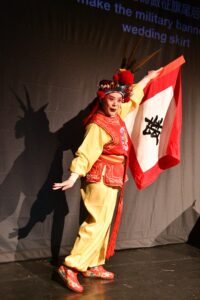
Covetousness – The Rotunda: Bubble – 8 May 2026 5pm
Covetousness is, as the strapline says, a lost classic reborn for the contemporary stage, which is also reconfigured for a twenty first century English speaking audience. It is no mean feat to produce an hour of ancient Kunqu opera in such a way as to entertain without losing some of its extraordinary “difference” and uniqueness. Take the fact that Covetousness is just one of a small number of surviving fragments of Kunqu opera, and is not even the full script, Jingkun Chinese Arts have to take full credit for their arrangement and editing to make it accessible. Producer Ruizhe Wang has delivered an exciting and enjoyable show.
My only prior exposure to any kind of Chinese opera has been the “newer” Beijing opera, glimpsed on Chinese state TV – it was spectacular but there were no subtitles so I was a bit lost. So this review is certainly inexpert in terms of background knowledge and contact, but Jingkun Chinese Arts company are well aware of the challenges of presenting in an outdoor geodesic dome theatre on a lawn by Brighton seafront.
The show starts with a video of questions and answers about Kunqu opera and segues into interviews with the actors playing the main part. The interviews aren’t just factual plugs, they talk about what the characters mean to them and how they relate to their own lives off stage. It is informative, yes, but it’s also warm and alive. At one point the female actor describing the part she is playing, often played by a young woman, describes how the character is adventurous and headstrong and full of vitality and ideas. “When she has ideas, then her eyes move, up and around”. It was this seemingly small point that helped me focus in on the character as played on the stage. Together with the exact and choreographed movement of hand and foot and body her eyes shot up, to the side, focused on the audience and were such an important integral part of the characterisation and performance.
The opera, or fragment of an opera is a two hander, plus a very talented musician. The music – haunting low and high flutes and pipes composed and played by the virtuoso Yuxiao Chen , tingling brassy percussion from a drum pad the other characters is striking and atmospheric. The voices are often high and mannered but full of life and expression – it’s a very unfamiliar mix to western English ears.
The story, as Jinghkun shape it, is of a powerful male character – the hualian – The Fourth Prince (painted-face male role played by Songyuan He ) who sends the huadan Xiaofan (female warrior played by Wanjin Li) to scout out a princess whose husband has effectively abandoned her. The huadan, Xiaofan, is the hero who journeys to the princess’s palace and returns with the story of her findings, making the rather coarse and overbearing hualian wait while she tells her story in detail.
Well that’s one layer of story – as it unfolds we realise that the long antenna of the the Fourth Prince’s costume are those of an ant – references to an army of 100 handpicked ant warriors and the like confirm that this surreal take is for real. It’s part of the wider context of the Dream of Nanke, the opera from which this scene is taken, which tells of a man who fell asleep under a banyan tree and and lived a long life of kingdoms, riches and princesses only to find when he awoke that he had been dreaming and the kingdoms were those of the ants in the ant hills by the tree.
The whole show is visually very strong, these vibrant colours accentuated by the very precise choreography where sleeves and flags unfurl and wave. A lot of movement is evoked on this small stage by the skills of the performers – the opera works by evocation and spectacle combined so that half the performance is there in front of you, in sound and vision, and half is what your stimulated imagination is creating.
It’s a very strong show that is unmistakably part of Chinese culture but enacted in a way that makes it accessible and understandable. The actors are very exact and their voices range up and into high registers, then down into low as they sing their speech, with mime and movement of head, hand body to accentuate the meaning of what is going on. There is a simultaneous translation in English and in Mandarin, but a Chinese speaker I talked to in the audience said both translations were approximate, just getting the flavour of the interaction. I felt this very strongly myself – sometimes I would be so taken with the voice that I would forget to look up at the translation, but I was still feeling the gist of what was going on.
This was pretty stunning stuff, to fall back into the vernacular. Despite being from a small piece of something from so long ago, Jingkun made it come alive and transported you on its weird and wonderful track. It was physical and demanding theatre, the two actors both had great poise and balance throughout. Their movement was very accurate and stylised without losing a sense of art and spontaneity. Wanjin Li as Xiaofan was full of life and had a commanding presence as the female huadan, , Songyuan He as The Fourth Prince, resplendent in his robes and mask brought humour and contrast to the lightness of Xiaofan’s portrayal.
Absolutely worth seeing at this fringe.
Both Chunxiang’s Schoolroom Prank and The Covetousness can still be seen in the Brighton Fringe at the Rotunda: Bubble
Chunxiang’s Schoolroom Prank on 14 May and 16 May – click here to book
The Covetousness on 15 May and 17 May -click here to book