





FringeReview Scotland 2026
The Whole Routine
Edward Thomasson
Genre: Dance and Movement Theatre
Venue: Tramway Theatre, part of the Buzzcut Festival 2026
Festival: FringeReview Scotland
Low Down
Through repetitive movement, and through song, six performers create a question, which is, should we behave differently in our daily space. It’s a physical joy of asking, moving and harmonising between six performers with exquisite presence. It speaks to tropes of theatricality to use the recognisable to innovate and challenge.
Review
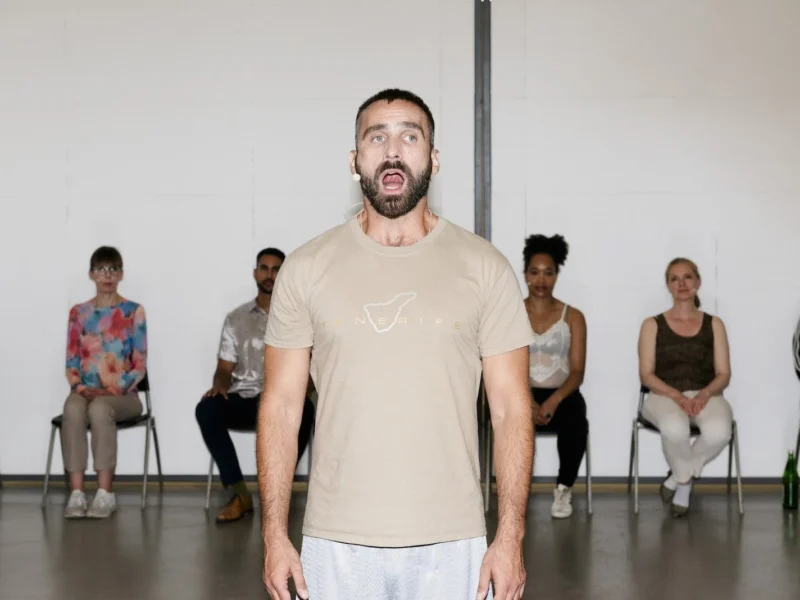
We begin with one performer using their voice to set us off. Afterwards the lights are up an off we go. The Whole Routine asks a simple question of our ability to comprehend and understand how to control ourselves, and if we should exhibit control at all. It asks us to consider our place within society but also our mind within our body and how it operates that body. Through individual songs and ensemble pieces of movement the six performers draw us into heir questions. It is an exceptionally funny, bright, uplifting, questioning, off the wall look at life.
Theatrically, as a structure, this worked exceptionally well. This is not just down to repetition but also due to the ability of the performers. Drawn from a variety of backgrounds, the stage was the leveller. I could not spot who had training, who sang in a community choir or who should shine more than anyone. It felt like an ensemble who supported the ideals and the ideas. It took three years to create and the spirit of collaboration with songwriter Robbie Ellen and composer Charlotte Harding, as well as the performers Adrian Quinton, Callum Murphy, Clara Andersson, Penelope Granycome, Simon Tipping and Yasmine Holness-Dove was obvious.
Very often art installation or radical theatre is critiqued as being less than what we think the mainstream ought to be. It is quirky, frowned upon, patronised because the technique employed is valued less than the mainstream. Here you had six performers who could move well, performed well and sang exceptionally well with harmonies blended and beautiful. They had the ability to use rhythms which we would recognize as more mainstream than radical, but they led to a real reckoning between the expectation that we have for radical theatre and the mainstream theatre practice that we expect in the mainstream theatres.
Pure genius.
The layers which built were impressive.
When the movement was disjointed and people were not in harmony, that built that sense of disruption, forcing us to consider the effects of literally and metaphorically being out of step.
What was equally impressive was that the majority of this was done with lighting in an open state. Thus, the engagement with the audience was doubled down on. We were no longer just an audience, no longer just observers, but in some way participants. So that when they asked that maybe there was another way to move gracefully through the day, we were asking the same question of ourselves.
The choreography was spot on. I loved the diversity of the people on stage. Nobody was as old as me, identified like me, but I felt represented, and am still trying to work out how that could be possible.
There was a real tonal blend that I could relax back into and feel that I was being taken on a particular journey. I was delighted at the end of it to be able to walk out along with the rest of the audience having seen “the whole routine.” I hope that there is a part two because I’ll come back to see it all again.