




Thessaloniki Fringe Festival 2026
The Bus
Chaotica Theatre Group
Genre: Absurd Theatre, Contemporary, Physical Theatre
Venue: Avlaia Theatre
Festival: Thessaloniki Fringe Festival
Low Down
An absurdist ensemble piece that turns a city bus ride into a carousel of scenes about the alienation and fragmentation of modern society. Inspired by the myth of Sisyphus and a Kafkaesque view of bureaucracy and social roles it has good costumes and a finale with emotional weight, but too many sketches and underused physical potential keep it on the surface.
Review
Staged by Greek company Chaotica Theatre Group, THE BUS is a one-hour-long performance leaning towards the absurdist genre, with elements of clowning and physical theatre, that, in the construction of some scenes, reminds us of plays by Eugène Ionesco.
The dramaturgical intention of the play is to display the alienation and fragmentation of modern society through a slideshow of daily-life scenes occurring inside a bus as it travels from stop to stop. Each scene is introduced by an automated voice announcement system which tells the passengers (and the audience) what the subject of the following scene will be, hiding it behind the name of the next bus stop.
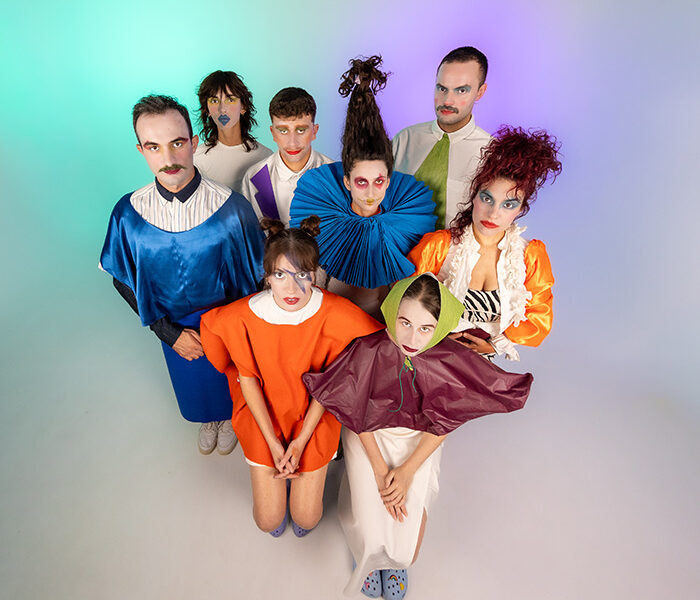
The opening of the play is well crafted, with a single actor taking centre stage and a clear blocking focus. She is one of eight actors interpreting the many characters we will see throughout the performance in what is a carousel displaying different layers of society: from the bus driver to a sex worker, from a priest to a street juggler.
All of them wear different shades of white face make-up and colourful clothes. It is a stylistic choice that gives the play elements of clowning, although the directorial aim seems to be enhancing the idiosyncrasy of each character rather than looking for comedic gags. However, this choice enables the play to maintain a certain lightness instead of becoming a negative, introverted snapshot of contemporary society.
In total, more than 15 scenes accompany the audience. While some of them are immediately relatable to routines occurring in commuting life, they all take an absurdist twist: from a ticket machine berating an immigrant because of his low card balance to a scene of mass hysteria triggered by the sight of a cockroach; from a ticket inspector who gets devoured by the passengers to a street artist transforming a juggling routine into a promotion of the benefits of vitamin C as an antidote to the stress of modern life.
Although it starts from an interesting set-up, the play does not go beyond the simple repetition of scenes. This may be intentional, as the myth of Sisyphus is deliberately quoted as one element of inspiration, together with a Kafkaesque view of bureaucracy and social roles. In Greek myth, Sisyphus was condemned to roll a boulder up a hill forever, only to watch it roll back down. In THE BUS, the commuters are condemned to ride the same route and see the same action repeated continuously every day, throughout their mortal existence.
The lack of meaning in what is occurring in their commuting reality serves as a contrast to develop a final scene reflecting on time, ageing and mortality, inspired by Greek mythology and cosmology.
Overall, THE BUS is a coherent ensemble piece with real strengths: the costumes are good, some performers stand out, and the final scene carries some emotional weight. However, the excessive number of scenes and characters does not allow for deeper psychological exploration or the possibility for the audience to create an emotional bond with them. Some gags are weak, the physical comedy misses some opportunities, and there is too much screaming.
It would have been better to cut the number of scenes or build them as sub-scenes within three or four main storylines. It feels like a play that still needs a lot of staging work in order to really take off. In particular, such a large ensemble of actors is almost never used beyond simple character depiction. The opportunity is there to develop great pantomimes and better physical staging ideas.
It is a play that touches on an interesting theme but does not exploit the acting tools it has or the hidden potential of physical staging.