







Edinburgh Fringe 2026
Box [M]
Flying Rabbit Circus

Genre: Dance, Dance and Movement Theatre
Venue: the Space @ Triplex
Festival: Edinburgh Fringe
Low Down
We begin with someone in darkness, searching with a torchlight and they discover a boy in a box. The visual metaphor works very well as we then explore how growing up as one gender often ends up with expectations and influence placing you in this tiny little space from which you struggle to escape.
Review
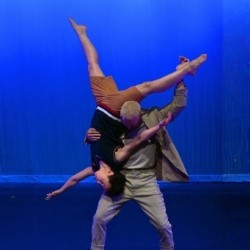
Flying Rabbit Circus are an award-winning company. Here duo of Landyn Endo and Kapi Lee explore and demonstrate the thrill and tensions of growing up transgender within an Asian American immigrant household. Created by Genie Cartier, Endo and Os Roxas, it has beautiful, tender movement throughout. There are two characters onstage who appear to be an elder sibling and a younger one. Their relationship works as the younger, smaller one challenges their partner through wishing to not conform or to challenge the accepted ways of doing things. And so, we get plenty of play, dress up and chores to be done – principally sweeping. They seem to do a lot of sweeping.
It has been choreographed with an understanding of not only the physicality of gender politics but that the growth from the ballerina to the boy is something that should be encouraged because it is an expression of self as opposed to being a denial of worth.
Our performers are exceptional. Their relationship is demonstrated throughout and much of the work in balance and as a duo is just beautiful. It’s not a circus act but there is a tenderness of emotion which comes through their touch and support, the looks and their relationship which really does waft over you. It’s in their hands when they balance, in their movement when they weave between each other, in their twinkly eyes at the end where anxiety and anger are released to become a deeper sense of love.
They tell a story through their movement and interconnection demonstrating that love along with the frustration. It’s a frustration of wanting to look after a family member who may be different, by trying to get them to conform so that others would not pick on them. By the same token, the respect that eventually emerges over time is demonstrated in a physical movement between them that is very close. The balancing has them dependent upon each other and supporting each other at the same time.
The choreography works because it has that childlike innocence at its heart. There are petulant physical rants or finding that doing chores in amongst play is being left aside to reach out and be a part of each other’s stories.
Technically, the set works very well, though at times I thought going behind the screen felt a little clumsy and clunky.
It is a well-crafted piece of theatre which shows trans exactly the way it ought to, as acceptable and accepting.
The music in particular, and I cannot deny being thrilled at any performance piece that has a bit of Judas Priest in it, was apt and caressing. What did not work so well was the projection onto black cloth and the sight lines from the second row which was on the same level as the stage. Navigating the heads of the front row left many struggling to see.
Box [M] reminds us, because we keep forgetting, that acceptance of diversity is a positive for us as much as it is for the people requesting that acceptance. There is such beauty amidst the touch and tenderness between that it would be cold-hearted to see it in any other way than as an astonishing addition to how we understand what true acceptance actually means.