






Brighton Festival 2026
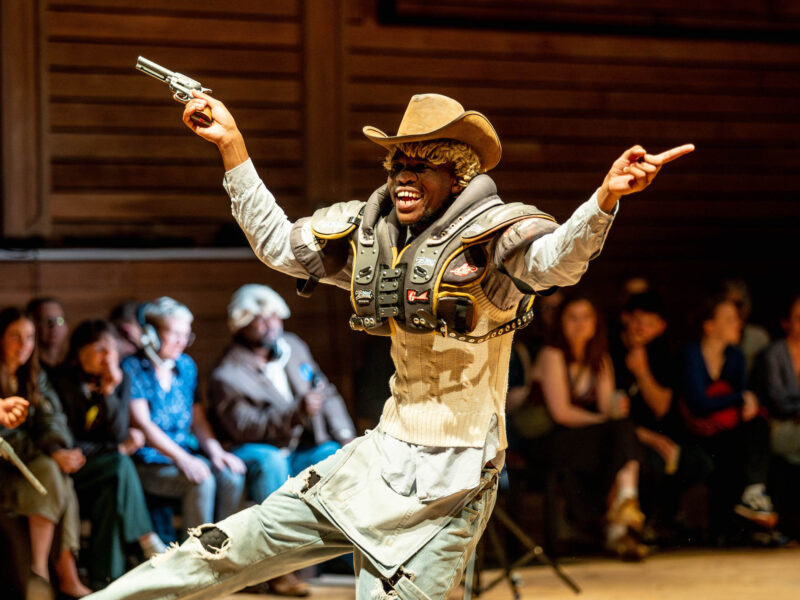
Dark Noon
fix+foxy, Glynis Henderson Productions, The Pleasance and Republique
Genre: Contemporary, Dark Comedy, Drama, Installation Theatre
Venue: Brighton Dome Corn Exchange
Festival: Brighton Festival
Low Down
Here we go, galloping into the Wild West with our ten-gallon hats and ‘this land is our land’ mentality. But wait…fix+foxy are here to tell this story through a black South African perspective. Does it alter the narrative? Not so much, but it does make you think anew. And it does so with incredible stagecraft and a superb company of actors.
The Cast: Mandla Gaduka, Kaygee Letsholonyana, Lillian Malulyck, Bongani Bennedict, Masango Siyambonga, Alfred Mdubeki, Joe Young, Thulani Zwane
Photo Chloe Hashemi
Review
fix+foxy’s exhilarating theatrical event is full of oppositions; darkness and light, joy and pain, history and conjecture. Sitting ring-side, it’s an immersive experience that seduces in its presentation whilst the story kicks you in the teeth. The tale of ‘how the West was won’ might be familiar and have been demythologised before, but the company’s choice to flip white for black and see it through an African lens gives it a whole new slant.
Faces powdered and sporting cheap white wigs, the six black and one white South African actors take us through chapters of American history, from the pioneer settlers, land grabs and expulsions of ‘natives’ through slavery, bison extinction, cowboys and frontier town life with its corrupt preachers and two-dime whores. Staged partly in traverse, with a rake giving a long view, the Corn Exchange becomes a desert landscape of raw ochre and burnt sienna; a huge screen projects live narration by actors in turn.
Collectively devised, then written by the Danish director Tue Biering and choreographed and co-directed by Nhlanhla Mahlangu, the ensemble multi-tasks in videoing, set-building, role-playing and audience interaction.
Most chapters are introduced by an actor on screen in close up, the depth of field reinforcing the huge scale of the piece, and have titles like ‘Gold, Gold, Gold’ (cue Gold Rush) and ‘Why Did You Do It?’ an interview with a squirming politician. The narrative does occasionally lose its way. A feminist spin on the role of women in the West, and male homosexuality amongst cowboys jar, but several scenes bring the hardship and injustice chillingly to life.
A jolly line-dance becomes a slave auction with cracking bull-whip and cries of “Look at that! Mad prizes!” The settlers clear the natives off the land in an American Football match, with wild live commentary on screen. Also on screen is audience member Jamie, his bewildered expression reflective of the general mood. This scene, like many, ends with gunshot. The audience is brought into the drama in other ways too, some are kettled in a cage, those more lucky get a drink of whisky. They, like all of us, bear witness.
Most impressive is the ensemble at work, switching characters and costumes as they build Johan Kølkjær’s deceptively sophisticated set. There’s no fourth wall here, the actors appear as themselves at times and expose the pure theatricality of their undertaking. It is an epic tale; less ‘How The West Was Won’ and more how Americans and Europeans skewered the landscape and an indigenous population. To do so with such wit and vision is well, epic. It’s great to have the Chinese community included too, who, as viewers of TV series Deadwood will know, did not fare well in this history.
A coda in which the actors speak of their relationship to the Western as a genre is illuminating. As one says “If you want to kill an African story, tell it English.”