























Brighton Festival 2026
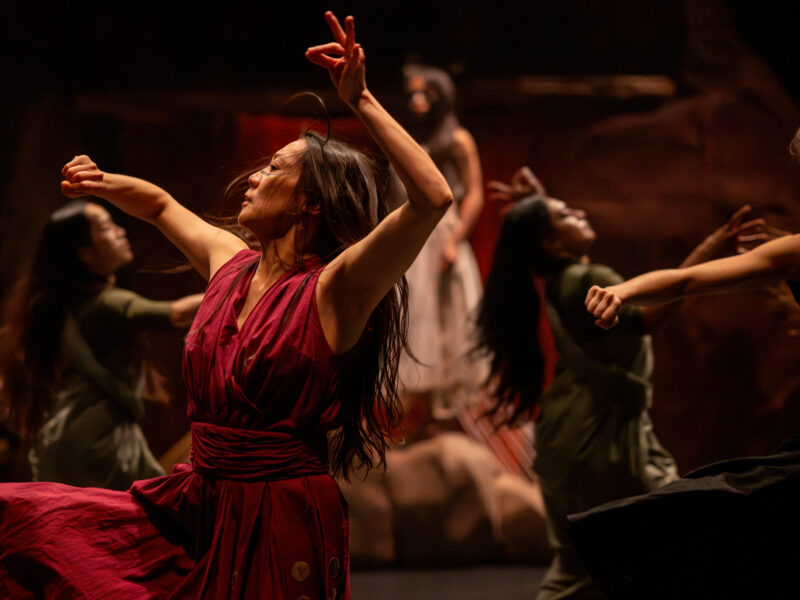
Thikra: Night of Remembering
Akram Khan Company, Akram Khan and Manal Aldowayan

Genre: Dance
Venue: Brighton Dome
Festival: Brighton Festival
Low Down
A tribe of women have come together to commemorate something. Choose your own way through the storytelling and watch for clues – is someone daubing their face? Is that puppet-like body being resurrected? What do the hieroglyphics mean? All is to play for in Akram Khan’s impressive dance-drama.
photo Camilla Greenwell
Review
Thikra draws inspiration from the vast desert landscape of Saudi Arabia and its cultural and mythological heritage; it was commissioned for AlUla arts festival in Wadi AlFann in collaboration with Saudi visual artist Manal AlDowayan.
It opens with a strong sense of ritual. A priestess figure, in a robe uncannily resembling a pod of peas, descends from a high, red draped platform back of stage. She’s met by an ensemble of women in grey sari-style dresses moving in unison, their limbs thrashing, heads rolling, like a posse of fanatics in a wild trance. It’s a strong statement of intent; we are drawn into an atmosphere of mystery powered by emotional expression and the sense that something sacrificial might happen. There’s a hint of the Handmaid’s Tale, white wimple masks, sinister picking over fallen bodies. A sisterhood in crisis.
But searching for narrative here distracts from the pleasure of watching the 12 strong company dance, in seamless unison and with amazing clarity of movement; they have such gloriously expressive arms. Central to the ‘story’ is a dancer in white, Ching-Ying Chien, who becomes the focus of sparring, by ancestors perhaps, or matriarchs. Khan’s work encourages the imagination to layer meaning on movement, but Thikra is most fully enjoyed if you sink into it. Aditya Prakash’s pulsating score (with sound design by Gareth Fry) propels but is overwhelming at times. Snatches of Bulgarian throat singing, Arabic song and a dash of Purcell’s heart-tugging Dido’s Lament catch the ear amid the beats.
Lighting Designer Zeynep Kepekli veils the action in spectral gloom (this is not a piece for people with impaired sight) giving the rare blasts of light on faces and bodies tremendous impact.
We may also have a new dance form here, the choreography of hair. It becomes a sculptural tool, magnificently shaped and vigorously wrenched, a symbolic emblem of womanhood in its glossy darkness. I would love to see the production budget line for shampoo.
It must have been quite an experience to see the work site-specific in the Arabian desert, where the set was built on rocky sand and the position of women in society so different. In the concert hall it looked a bit like a Star Trek set, the rocks and bones lacking heft.
What stays with you is the deeply conveyed commitment of the dancers to the material; the journey turns their bodies to quicksilver as they embody some powerful inner force. Limbs melt and fold one minute and thrash with fury the next. The largely female audience was instantly on its feet as the piece closed in darkness. Some kind of rebirth had happened and the room reverberated.