








Brighton Fringe 2026
One Foot in the Dark
A collaboration between writer & poet Saili Katebe and movement artist Divija Melally.
Genre: Dance, Performance Art
Venue: BN1 Arts
Festival: Brighton Fringe
Review
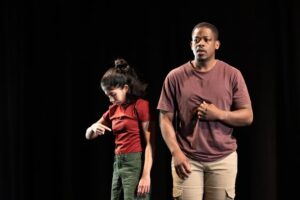 This was two dance pieces, one solo, one a duet. The first solo performance is a virtuoso piece from Divija Melally. Simply dressed in white clothing she alternates between wide sweep gestures and louder stamping rhythms from traditional Bharatanatyam dance. It’s an effective mix into which she adds a spoken element, a word, then another – two together, then three building up to a nearly complete sentence registering the fear and jeopardy that can arise in someone with dark coloured skin just walking past someone else in the road. This is not simply about overt racism but about the tension and anxiety internalised in everyday existence.
The dance also refers to commonality of experience, the underlying whiteness of the skeleton underneath symbolised by the bucket of strange white balls she tips over her head and lets cover the stage. This was an almost awkward symbolic moment – these light polystyrene balls skidding over the floor, snow that wasn’t snow, a random structure under which whiteness is both an abstract concept and the very material colour of bones underneath it all.
The second piece is a duet, where Divija Melally is joined by Saili Katebe. Initially they paced very slowly and deliberately toward centre stage, together in unison. Their dance movements play off one another, driven by Saili Katebe’s strongly voiced poetry. As the performance progresses the dancing becomes more physical and almost acrobatic. Saili’s voice drives home a world where “they already know where North is” is a strange, almost surreal concept – after all we all know where North is – but made cold and alien, a rebuff to those from other climes. The words are declamatory again, both pointing up that which is cold and unnerving, or simply stating “I chose this” – the tone varies from abstract to personal.
Things become more personal and dyadic as the two dancers swirl and whirl together, hanging on desperately, picked up and flung over the shoulder, both violent and gentle.
The thing that struck me with the first dancer , and then struck me again more forcibly with the second duet was that they could have done with more space. It was just me feeling that the dancers were working within the confines of a relatively small stage, and perhaps this feeling of confinement was quite in line with themes being treated.
You could sense that there were rhythms and shapes that came from more traditional dance in what was quite austere modern movement and that there were themes of alienation, separation, closeness and love in a kaleidoscope of different forms and shapes. As the performance drew to its end the movements were stronger and more definite, but Divija Melally’s speech was more personal – “I chose this, to pursue my dreams”
Overall this was quite a difficult show to take in and understand, you had to stay with the movements and dance without interpreting or seeking complete understanding. It leaves the audience with a lot of work to do, it’s not a feel good piece, it’s experimental. The words helped because they gave you something tangible to encounter, but they too were not unambiguous, they too were redolent of things we do not understand – “a room of wreaths not roses”, was one fragment that stuck in my mind.