







FringeReview Scotland 2026
Bloom
Kai Sakurai and Monika Smekot

Genre: Dance
Venue: Fernhill Community Centre
Festival: FringeReview Scotland
Low Down
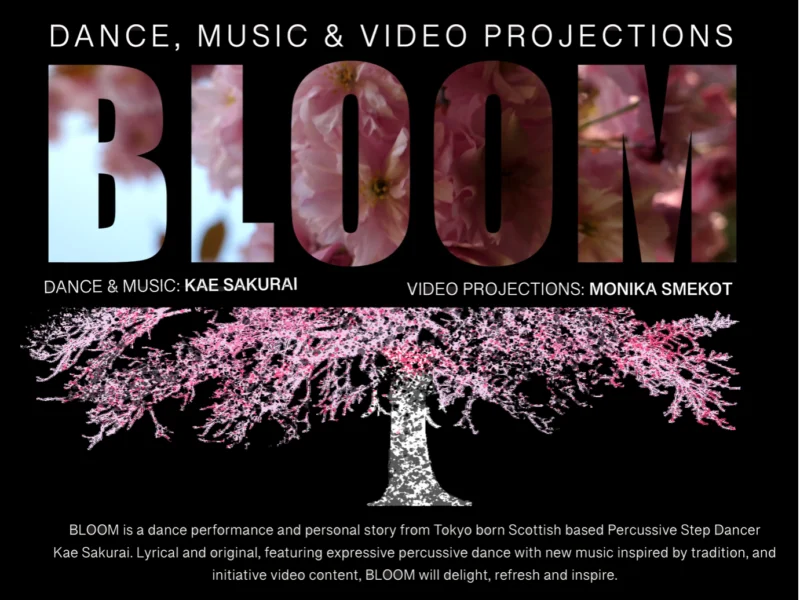
Bloom tells the story of Kai Sakurai, born in Tokyo, who came to Scotland to study Highland country dancing, but eventually became enthralled by Cape Breton curated stepdance – originally a Scottish form of country dancing which, at one point was banned by the Highland Country Dancing Association – which she now practices and teaches. Bloom uses ten sections – The bird, the bell, fish and the tree, Roppongi Reel, Kelvingrove Dancrs, Bainne non Gobhar (Goats’ milk), Many years, Kae’s tune, And So On, Rhythm Cannon, Swedish Broom and Sakura (Cherry Blossom) – to tell her tale but also to platform stepdance as a dance form. It begins with Sakurai playing the hammer dulcimer, then dancing, with and without projections before she returns to play us out of the performance.
Review
The resurgence of stepdance has been a cultural boon to dance in traditional Scottish dance circles. It is rhythmic and explosive as it percussively lands on the floor. It demands your attention so having the delicacy with which Sakurai takes this dance form is an absolute treat.
The beginning of Bloom with the animation around the bird, the bell, fish and the tree – a nod to the Glasgow’s Coat of Arms – is a subtle beginning which creates a mood of expectation.
From there it does not so much explode as expand into the clever use of projection and dance. Sakurai is an excellent exponent of the dance form and here shows a true democratic approach as her Kelvingrove dancers feature heavily on the projections, often with Sakurai dancing alongside live as the recorded visuals enhance the sound. We are introduced to this troupe through the projection of tenements, much associated with the area in which you find Kelvingrove as each window is converted into a dancer’s stage. They join Sakurai in performing and it is the beginning of some neat and well imagined work with technology. Sakurai performs in triple on the screen and quadruples it being live. At one point her onscreen presence arrives with a cup of eta to observe and this confident interplay shows that this is a confident fusion of what has been in our past, along with the ever-increasing use of technology in our present and future.
Musically it was filled with tunes to enhance the dance. It was no minor partner but a supporter in a symbiotic relationship that cemented the emotion onto the movement.
Technically, given we were in a sports hall, this was well imagined and delivered. It felt theatrical and the use of three screens which were moved and manipulated for effect worked really well.
The use of an excel spreadsheet to show Sakurai’s journey and the steps she had choreographed was very interesting and whilst I knew what it represented, I wondered if there was context which could be shared more to help those unknowing to be enlightened.
That aside, here was I, in a community centre, in the southside of Glasgow, watching a Japanese dance, who has lived with us for more than two decades, dancing a step that the Scottish Highland Dance Society tried to ban kept alive by Cape Breton influences off the coast of Canada, until we could pick it all up again, celebrated by a full house of dancers, locals and people who just wanted to celebrate – sometimes I pure love my wee country…