









FringeReview Scotland 2026
The Corinthian
A Play, A Pie, A Pint, co-presented with Assembly Roxy

Genre: Drama
Venue: Oran Mor
Festival: FringeReview Scotland
Low Down
The Corinthian tells the tale of Andrew Watson, born in British Guyana of a Scottish father and a native mother, who at a very tender age moved with both to Greenock. Landing there his life transformed from the carefree plantation owner’s son to a legendary figure in Scotland’s national sport. From joining local boys for kickabouts until a trial at Queen’s Park Football Club, Watson became one of their most important players in the amateur code. Eventually taking the shilling and signing for English team Swifts FC as a professional, he became Scotland’s first black captain in association football. Watson observed the very first football game between both Scotland and England, made his debut against Wales and then captained Scotland in the very famous but long-forgotten 6-1 victory at the Oval over the Auld Enemy. He also saw the worst of us which led to the early demise of his mother and suffered at the tongues and side eyes of many of his contemporaries.
Review
From the pen of award-winning black writer from Glasgow, Joe McCann, The Corinthian highlights and touches upon many major issues that Watson himself had to face. Much of the issues are ones with which we stull deal and the tragedy of Watson’s time is not fully explored. McCann’s script manages to scratch many of the surfaces without delving into the details. I wanted much more emotional depth, and it gave Dayton Mungai as Watson a tough job. He is an engaging presence with
the enthusiasm with which Watson had to be infected to survive. Of course, Watson came from a privileged background, meaning that much of the racism that he faced was going to be ameliorated to an extent by the reputation of a rich father. And that, in a sense, is where I wanted to ee more depth. As a footballing story we hear about his determination to stay in the amateur code ten as a side note he didn’t. how? Why? The death of his mother? I wanted more of how he dealt with it.
The fact that Watson was a footballing giant in our history, but is much forgotten, is in itself cause for a 45-minute piece of theatre but the story of Watson himself, the connection to their plantation is never really developed – that fascinates me.
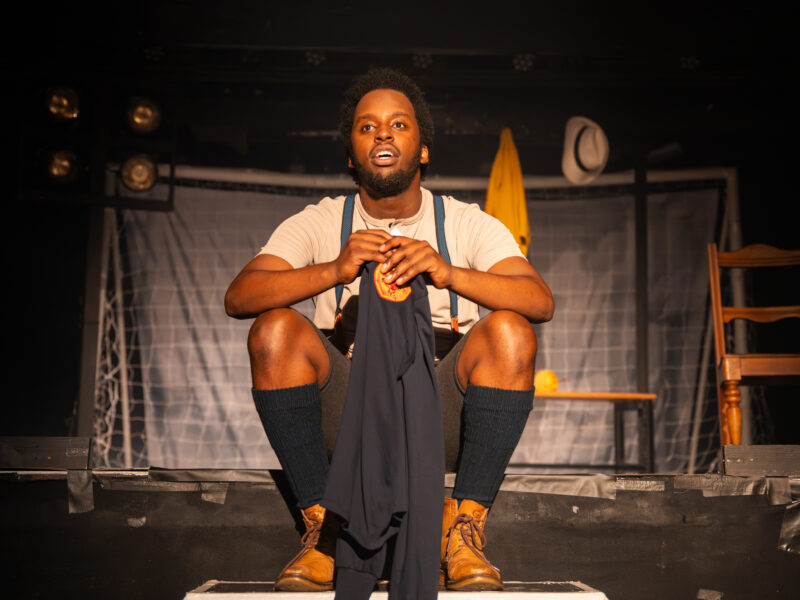
Director Martin McCormick has successfully managed to develop a tale which does manage to take us from Guyana to Greenock with a well-produced piece of theatre. It is done with a lot of grace and a great deal of skill, not least Mungai himself demonstrating fleet of foot when he was able to pick up the ball from the floor without ever having to bend down.
Set designer Heather Grace Currie has fashioned from nothing an impressive backdrop, but it served as a backdrop. At times I felt it could have been utilised a little bit more – hints of floodlights and the goals in place never really featured.
Sound designer Ross Nurney and lighting designer Ana Reid successfully create the period of the time, as well as the lighting that takes you from the hot times in Guyana through to the cold climate in Queen’s Park at Hampden.
The Corinthian tells a story that should be on the front of the Hampden Museum. It should be in the hearts of every single Scotland fan or the heads of every single Scottish footballer who during the summer is going to carry the hopes of all of us in America, Mexico and Canada. The fact that it has become not even a footnote in the majority of the history books is a travesty and something that Scottish football can often be very guilty of. To have this opportunity to hear some of the major events in Watson’s life felt less of a privilege than a guilty memory for those of our ancestors who bolstered prejudice and slavery -but in what side was Watson and his family – liberators or exploiters?
By the end I walked out wanting to know more and there were plenty of questions left unanswered. That is perhaps the problem about doing a whole career in 45 minutes. Or perhaps it is exactly what theatre should do, ask questions and allow us all to walk off with them to go and do a little bit more digging. And I did a little bit more digging.