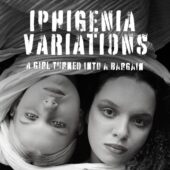
Four actors led by writer/director Sofia Stavrakaki enact what’s clearly a prison of a circus, people forced to perform a ritual of trouping for the delectation of a whip-cracking elite. A summary hardly does justice to the atmosphere this production evokes or the meta-language burning through the glares of hallucinated prey. You’ll know whether it’s for you if you like Beckett or European theatre
What’s in this name? Eglantyne means a prickly rose and smells by any name bittersweet. Founder of Save the Children who burned herself out in its service. This is enlightening and moving in equal measure, not only rendering a great service, but asking after Eglantyne Jebb’s breath-taking leaps of empathy, how far we’ve come since.
It’s not been done like this before. This play fully deserves its accolades. Though we associate the First War Pals Battalions with the north (the Accrington for instance) this show localises it to every community it tours.
‘It’s about this nurse.’ Angelica, former nurse to the Capulets sets out her moonlight vegetables quite literally. The essential point is that’s it a fascinating take, and a compelling story.
I loved this piece and so, I think, did the audience on the first night. The cast’s comic timing is second to none. Go see it and be confounded by this fine troupe who deserved all the applause they received on the first night.
With its low tech props, starkly minimal staging, and exquisite performance, Clevillé has constructed a piece that teeters between being hilarious, heart breaking, and intensely hopeful.
This is a stunning rediscovery, brought by director Justin Audibert and Troupe. Boasting a first-rate cast this superbly-wrought production measures its consummate leannness to the verse. We need more Shirley and this production should enjoy a longer run next time. It’s is a must-see even for those not normally interested in the period. Its plots and words still wound the air.
A finely-balanced play, not on the issues, which Beaton takes as open-and-closed. But in shading the opposition to Anne Reid’s reluctant campaigner Beaton shows warmth, humour and touches of compassion. Anne Reid comprises dignity and resolute panache in equal measure. James Bolam, apparently a beat behind, charms and rivets attention by turns. Harry Hadden-Paton’s PR Joe is a magnificent, unrepentant performance of sheer nastiness and Michael Simkins’ hapless oilman surprisingly sympathetic. A play that sharpens our tools for thinking and falling about with blunt laughter.
A good evening out and if you’re in the area, more than recommendable. The overall production and costumes, abetted with strong pace, a good use of Coleman’s narratives and finally finally top-flight amateur performances by Jennifer Annetts, Aisling and Thomas Edie, and Charlotte Eastes, makes this a recommendable production, the most ambitious I’ve seen from these players.
Simon Stephens has been exploring music and now dance in this piece inspired by his collaboration with choreographer Hofesh Schechter. Maureen Beattie’s intensely committed central performance is worth absorbing, the ensemble make flesh as much of Stephens’ text as could be asked. This feels like a text that needs to risk pushing through more specificity without fear of losing its suggestiveness.
Don David Tennant’s priapic thrusts might rise above the title but of course he’s in the classic armour (aka condoms) of two guvnors, Moliere and updater Patrick Marber; it’s exhilarating. This is one play you must see, so transcendent in its theme it asks you the same questions.
Together with textual revisions making this a newly-definitive production, with the cast re-moulding it and above all Hollander’s superbly faltering diffidence, this is the outstanding revival of a play in the West End this season.
This is a very fine revival of The Real Inspector Hound, counting on timing as much as the consummate Hughie counts on pauses. Potton is the commanding presence in Stoppard’s farce, whilst Messingham’s Erie is an exceptionally observed teeter to despair and a sudden lurch back. You wonder what he would have made of the 1930s, and how O'Neill might have answered him.
This masterpiece of courageous refusal gets one of its finest performances in recent memory. Proctor’s decision and Slattery’s delivery of his great lines: ‘Because it is my name! Because I cannot have another in my life!’ rings down this supreme testament to honesty – to bear false witness and incriminate others to save oneself - in the face of tyranny. Slattery defines this role in a way very few have; his energy radiates through a superbly lucid, passionately argued production.
Everything in Out of Blixen is realized with a magical economy. Kathryn Hunter’s s in her fluid element here, morphing into twelve-year-old girls and seasoned dowagers to her own directed paces The Europhilic Print Room has transformed the Coronet’s circular space into a consistent vision of theatre.
Daniel Radcliffe’s Rosencrantz is the box-office draw, all bemusement, beautifully drawn out in a hollow-cheeked slow horror of his lot. But it’s as Guildenstern that Joshua McGuire’s sashay from affront to despair through bemusement encompasses the open-mouth ‘lads’ Hamlet greets both with. And David Haig’s Player knowing he’s the opposite of a person insulates his reflective volatility from extinction. On the fiftieth anniversary of its Old Vic debut, Stoppard’s early masterpiece still startles in such a first-rate revival, protesting life to the black-out.
Dorothea Myer-Bennett is simply outstanding in her unravelment from uffishness as the heroine Sylvia, to a self-discovering naked passion prepared to offer anything. That’s the essence of a playwright too-little seen who’s provoked the most blissful comedic production this spring affords. Outstanding in nearly every way, it’s another gem from Richmond’s Orange Tree.
If we’re impressed with overwrought maleness then finally it’s the women who impress most, who render service to a tragedy mired in the perennial soldier’s fear: betrayal.. Invigorating, and a future mine to other productions, this Othello opens a trap door.
Raine balances articulate ferocity with its opposite: a broken plea. Exceptionally well-written Consent’s clean logic and logic-chopping with consequences, amplified with a pinch of myth, indeed poltergeists, might well become a small classic.
Ahmed’s writing in Ready or Not for the women protagonists makes you wonder what life, not Ahmed, will do with them. It’s a tribute to a dramatist who dares, and to a sense that this drama has another within it, signalling to be let out.
Neil Bartlett’s adaptation of The Plague plays on the mind as it’s meant to. Ferocious simplicity and pared choices make for an absorbing evening. Shorn of props, video projections or naturalist distractions, we let the piece seep in. Bartlett knows such brutal relevance never needs underlining, as we look at homeless Syrians and those of every ethnicity shivering in an unsuspecting city.
How do you tell if you’re starting afresh or writing a longer suicide note than Labour’s 1983 manifesto? Even if he can’t nail the specifics of the volte-face, Waters comes tantalisingly close to defining such a political moment in this short drama of the founding of the SDP. With acting as superb indeed commanding as this, it’s a privilege to come away watery-eyed from raw leeks.
Plews and Wicks have created a musical powerhouse literally all-singing and dancing, of the highest West End standards. The quintet – and they blend magnetically together – of Clifton, Barrett, Rush, Glover and McDuff have stamped character and stomped bliss on this musical.
Susanne Crosby’s Waiting for Curry – a title suggested by friends as they indeed waited for a takeaway – is a four-hander with a social reckoning, a denouement, and a very unexpected plot point. An excellent play and cast needing wider circulation; the audience was packed.
Tamsin Greig’s extremes as Malvolia mark the first intimations of the terrible and define this production The only caveat with this predominantly youthful cast is that January’s chilly ivy hasn’t pricked more fingers. But the ground’s shifted.
Informative, infuriatingly endearing it’s also Cohen’s first masterpiece, however small-scaled. For that reason too, it holds a particular freshness, a discovery of a remarkable voice. Or two.
The famous adage of farce as tragedy played at breakneck speed begs questions of how much pathos Moliere wished to inject, how fast he wanted to go in The Miser. All teeters towards the tragedy of the absurd. This may not be 1668 very exactly, but it’s the nearest to one side of Moliere we’ve seen for years, and conveys something of the shock of his new.
What Yellow Earth manage so well is to forge a contemporary life for Tamburlaine. Stylised, stylish and sassy in the best sense, this touring production make Tamburlaine accessible. With caveats noted, it renders the first early modern English language play the greatest service: a horrible relevance.
What’s so distinctive in Torben Betts is his misleading us into an almost farcical comedy that turns darker. Just as stereotypes settle, plots unravel them. The climax is devastating, not explosively but in revelatory shudders. A fine unexpectedness marks both this superb play and outstandingly-acted revival.
Slapstick comedy is difficult to bring off, even more fiendish to write. Tomlinson’s cast turn in here a performance as fine as anything I’ve seen in Lewes. Most of all, Kelly’s superb play in their hands lowers not a tap in one of Franklin’s thermometers to any professional production.
In the best sense this production’s stupefying, a spectacle shot through with theatrical tropes suggests that, if Evan’s revelations could be more frequent, Kid would be dramatically breathtaking too. And it is thrillingly itself.
Quilter’s best known for Glorious! and End of the Rainbow. His output’s devoted to theatrical experience; his obsession’s fed into performative actors, mainly women. Quilter doesn’t allow obvious endings, or neat ones in this touchingly funny homage to theatrical living. This production does as much for The Actress as any revival anywhere.
Out of Order is a superbly revised first-rank farce with not a weak link, furiously paced featuring perhaps the only time the window (in person?) gets a curtain call.
Morell relishes Fletcher and Massinger’s 1620 The False One, paces with an alacrity and eddy of detail that anchor memorable scenes. That’s enough in an uneven drama skewing Caesar and Cleopatra from the core of the theme, ‘false’ Septimius. There’s Fletcherian flashes of poetry throughout (all smoky arrows). Perhaps trimmed this play might still provide the period’s one essay on this subject, whose theme of loyalty trimmed, suborned and occasionally redeemed must strike us as horribly perennial.
Pat Boxall paces this production with the pause and sudden rush Rattigan often asks for. Emmie Spencer’s subtle anguish as Hester carries the arc of this production superbly; with the twist of a half-smile she makes Hester vulnerable, indeed loveable, less heroine, more human. Happily her consummate Hester is answered here: in the scale of production, in Jeremy Crow’s empathic, passionate plea for life as Miller; and a host of supporting foils from cast members.
Led by Cherry Jones and Michael Esper, Williams’ fresh map of hopeless chances freshly realized, in a revival whose pitch is as perfect as the flowers picked off Amanda’s mouldy dress.
This Hamlet shouldn’t be remembered just for Scott’s improvisatory humanity, though that’s key to what follows. This work emerges infused with family tragedy, intimate disquiet and treachery slant.
Swale’s unique: she writes a play of feline-scratching wit that’s a feelgood hommage, where intellectual pyrotechnics never feel out of place. We’ve recently enjoyed The Libertine’s brilliantly-lit darkness revived too, and revived Nell Gwynn is the antipode to Jeffreys’ profound masterpiece. Just as clever, as fiendishly witty, Swale’s orange-girl raillery refuses the other’s command to dislike. It ends too, in a startling reality, and tenders a shock.
Lindsey Ferrentino’s 2015 play Ugly Lies the Bone confronts three issues in one. PTSD and military women power many debates, as does virtual reality therapy. The play’s double thread means fruitful collisions in this open-ended approach suggest a scope that can’t be worked out in either. Despite slightly pat consolations, this drama that readily breaks out of those intentions. Fleetwood’s on stage virtually as it were the whole time, overwhelming in her shuddery defiance.
Claire McIntyre’s Low Level Panic might seem a slight play at seventy-five minutes of apparently low-key plotting and vestigial images, but after thirty years it loses nothing in impact. Time’s conferred both an indictment and uneasy classic status to this masterly first sliver of a much-missed dramatist.
A fine curtain-raiser to a year of Massinger, a later Jacobean whose career took a while to fly, was always poor and eleven of whose plays ended as pie-liners. There’s fifteen solo-authored and many collaborations to discover, several in this year’s RND. Frances Marshall ensures a superbly spirited ensemble piece, with apposite small props and a freshness you can smell. Though three hours with a break this never once even falters; it’s as realized a performance as you could ever wish, touched with scenic brilliance.
As a snapshot of political compromise and impossibly contrary pressures African politicians encounter, it’s of the keenest interest. Agboluaje’s characters are vivid, and in one great scene they breathe fire.
Sad prostitute meets superannuated virgin in 1962. A fine thoughtful and very welcome revival, with Leah Mooney and Des Potton bravely baring all their vulnerabilities at the least.
A joyful sadness more nearly than most strikes the balance Chekhov mockingly prescribes in The Cherry Orchard: a comedy, grasping a clutch of infernos. Jade Wlliams’ grief-clenched crumpling as Varya perhaps steals the show but Simon Scardfield’s misery-infused Epikhodov, Abhin Galeya’s weedily gauche Trofimov and Sian Thomas’s giddy Ranevsky round out a memorable whirligig of a production.
Amanda Whittington’s feelgood Ladies' Day finds Seaford Little on fine turf. Wright and James particularly together are a delight, and Faulkner’s pitch-perfect Donegal Patrick not only brings the whiff of paddock and angst but allows Forshaw to glint, contrasting her well-founded characterisation. Picott paces a sterling production from a small house, with moments of brilliance.
There’s no swift way to convey duende, the spirit of flamenco, passion and tragedy so unrelentingly – and there’s not a hint of comedy here, no shading to hide in. This hugely challenging drama stamps out its soul in this courageous, literally no-prisoners production.
Rourke directs a wonderfully lean vehicle for Shavian dialectic as furious power-play. Aterteron bestrides the board table as a scruffy colossus who brings it values to collapse all shares in any market. She has to burn. It’s something we need reminding of.
Tim Key, Paul Ritter and Rufus Sewell dazzle in this Old Vic revival of ‘Art’ directed by Matthew Warchus. Reza joked of her Olivier Comedy award: ‘I’m surprised, I thought I’d written a tragedy’ and this visceral but almost (dare one say, given the subject) cubist probing of the hairline crack between the two both affirms and denies Reza’s claim she’s not a cerebral writer. She asks dangerous questions of just what the ‘art’ of friendship consists of, and why.
Richie’s layered and occasionally skewed avuncularity brings a troubled warmth to Grace, a baffled tenderness. Nothing is as it seems and though McKenna has telescoped and altered the ending as such, the plot as presented falls apart in impossibilities. James is praised for exceptional plotting and vital elements – perhaps mere moments - are missing. It makes for a thrilling if improbably ending.
The gender-slashing part of Vittoria demands venom and defiance as well as passion in verse. Joseph Timms and Kate Stanley-Brennan as Vittoria shine delivering Webster’s verse, pointing up with defiant splendor or self-delighting braggadocio tinged with Trainspotting. Ryan’s pacey revival is timely, thrusting us to Webster’s sadly timeless themes. But misogyny’s purged of its merely temporal strut with the force of such verse inhabited, which lays its living sinew bare.
A first-rate revival of perhaps the classic stage thriller. Young and Blackledge bring fine characterful energy to their roles, as does Anderson, but the evening belongs to the range Tointon brings to her psycho-Cindarella role, and the gravelly improbable Prince Charming ‘old enough to be your grandfather’ Keith Allen. Banks’ pace never slackens: everyone’s given enough rope at the end to manage anything.
Escaped Alone frames four women chatting in deckchairs in this everyday talk of tea and catastrophe - just as one of them steps into the void to prophesy a smorgasbord of Armageddons. The protean Churchill touches yet another dimension too. Do we have to wait to her eightieth in 2018 to proclaim her our greatest living playwright?
It was the third and last act mingling high farce and near-tragedy as it does, that pitches this part of the already superb performance to outstanding by any standard. The legendary production by Druid Theatre Galway in 2009 came to mind. This part of the night is on a par with it. There can be no higher praise.
Winter Solstice, Schimmelpfennig’s apparently naturalistic fable is more than timely. As a dead-of-winter warning, it urges us to recalibrate, rewind our imaginations to the point where we might stop the tide of reasonable boundaries tightening into a noose.
Mid-period Pinter’s almost superseding the early ground-breaking works in popularity, and for good reason. Along with the later Old Times and No Man’s Land, The Homecoming’s recently been revived and re-appraised. Culann Smyth’s interaction with John Tolputt fascinates; and Smyth’s terrors jump out with reality. O’Shea has paced this with a tread that we follow down to the last triangle of light. A superb revival.
In a production fraught with controversy, Barker also refuses neat answers when he can fray us with questions. He’s certainly managed that, both inside and outside the play – which should be remembered, paradoxically, as one of his warmer offerings, in a memorably hypnotic and beautifully wrought production. But it’s time Barker brought himself in from the cold too.
Erin Doherty gives a quite brilliant portrayal of someone rendered nearly voiceless who on occasion has to find a desperate authority and at other moments, aspire. Rarely have the terrible antimonies of work and benefits system been so precisely notated, and never the combined effect calibrated to crush out young lives so mapped. It’s an essential play that charts the betrayal of a generation.
Gorky’s 1902 The Lower Depths is a vividly long evening, and holds the attention, but a huge challenge to pull into the shaggy shabby masterpiece it is. We emerge drier-eyed from this production, but it’s a bracing winter play, and all too grimly calls us out to act. It’s a seminal drama too, rarely seen, making this an essential pilgramage.
Supremely realized by Stevenson and Williams, Icke’s triumphant production dispenses with trappings save to point up the reverse symbolism at the end which like all opposites fuses into one lost head in two, as both queens’ final gaze burns like scenes from an execution.
This devastatingly detailed play is a quiet shouter, and the more harrowing. Its terrible legacy is that with a few term-changes, it might be played in thirty, fifty years. The poor and destitute seem to be needed to calibrate, even manifest obscene wealth in their opposites. It should send people into the streets, but then it already has.
Occasionally opaque, van Hove frames his eloquent prison with enough space for Greek tragedy and his uniformly fine cast to project it, however skew. Wilson’s supreme power, refracted through the cataract of this fitfully illuminating production, is to convey the sense that whatever role she might have chosen, Hedda’s grown up dead.
What makes this outstanding is Penhall’s wit and deft charactering of core band and satellites who interact with the complexity of a play, the way the songs move the narrative forward and are given believable geneses. This outstanding musical deserves the awards its original incarnation garnered – and it brings back The Kinks forever sharing the peak of British pop with The Who, The Stones and pre-eminently The Beatles.
It beggars belief that on one tiny stage we can be subjected to so many scene stages so expertly handled, so many backdrops and scenery shifts, not to mention a cast of twenty-two who can all sing. This production is good enough for a larger professional stage. If you get a chance, ask for a ticket or return.
Ninety seconds into this newly-revised one-woman play, Joanna Rosenfeld - emerging in a poke of fingers from a cagoule of brown paper - over-voices herself giving witness to tens of verbatim experiences we hear. This tells us the baby’s a parasite, sucks all your nutrients, calcium from your teeth for instance, causes injury, often permanent, can kill. This is - literally - epic interior theatre.
A Cymbeline that redefines the title role. This is perhaps the best mostly-uncut Cymbeline we can hope for till our nerves settle, but then again Cymbeline’s a state-of-the-nation vehicle, and has come again into its own.
Walter’s is a reading riven with pained clarity – a conflicted anguish visibly traced on her face – sealing the broken majesty of this performance. It’s the pinnacle of the rough magic of a production fresh, streetwise with animated verse deliveries, vocal range and above all the new-minted, brave new world.
The towering gender-slashing part of Vittoria demands venom and defiance as well as passion in verse. Peak delivers these with the kind of nuance in extremis that makes one wonder what more she could do with the part. As her brother Flamineo, the flame-voiced Bennett has great potential as a verse speaker, based on the rationale and clarity he brings here. The great lines at the end comprise the finest number of exits in drama.
Admirable high-quality festive fun; an excellent script well worth reviving and indeed sourcing again for others, a crack creative team particularly the musical numbers, and a cast who for the most part are at home with whiplash RP, particularly Jack Edison who’s never tongue-tied once. Enjoy, and note the extra matinees.
This work’s even more urgent now human rights in the US and elsewhere are temporarily at the least regrouping. Kwei-Armah’s pace and dance made this beautiful to hear and behold, but even more to absorb. An all-black cast has been a long time coming.
This devil’s bargain of a drama is how one generation takes responsibility for the ecological box of spiders it’s let out. One strength lies in avoiding the obvious. For one thing the children are absent. Kirkwood’s masterly play resonates with macrocosmic power, towering over the minutiae of living.
This is consummate storytelling, and Moorthy’s narrative variables attest to pitch and speed, a charactering that gifts all it can to the individual and in some cases real tales. There’s much here we cannot forget.
It’s clear something miraculous and patient is born from this simple but endlessly detailed production, releasing The Tempest into its fullest consciousness for a long time. However many Tempests you might have attended, see this one.
This swiftly moving neatly snipped production holds attention and the verse rationales of Parke, Bulman, Rankin are bestrid by Hellyer’s revelatory Cassius. It’s worth seeing for that alone.
The show - nearly three hours - never for a moment seemed it, gripping the audience so tightly the whole audience rose spontaneously to its feet – something I’ve not seen in this theatre. The blend of definitive and new cast members in a recent classic has overwhelming impact.
The Comedy About a Bank Robbery redefines the category, by edging beyond even recent work and revealing a classic structure entering a hall of mirrors and going mad. The musical as well as general ensemble is the most remarkably timed I’ve ever seen in a theatre, and the set designs and shifts the most frantically split into milliseconds. This is an outstanding and redefining farce in every way.
A bare interior of untreated wood encloses three black-clad women from the 1700s sewing. A candle gutters; it’s a bleak simple life. This is a bold quietly brilliant play asking questions of how we are thought, not think and how that impacts on what we take for feeling.
Dominic Cooper’s Rochester is up for it, as he tells the audience. Jeffreys has assured us of the finest, shrewdest, darkly poetic play of these times the centuries between have ever known.
Sub-plots in The Fancies Chaste and Noble reveal vivid parts, the dramatic language and one or two plot elements fathom the great dramatist of ‘Tis Pity She’s a Whore and The Broken Heart. If Ford’s great dramas were regularly performed, people might forgive this comedy almost as much as they do Shakespeare’s Two Gentlemen of Verona.
A consummate delight in this now rarest of forms; a tight song-and-dance of words. New material sizzles, inserted towards the end, the whole box of Bards from Bernard Levin’s Quoting Shakespeare to McKee’s arrangement of Shakespeare lines for a musical lights-out dances on the edge of hilarity before falling headlong into it.
Spectacle costumes and use of machinery are outstanding, even by Wanamaker standards. Granted there’s a lower dramatic threshold in Comus, it doesn’t mask as it were the fact that this is the most outstanding production of Comus we’ll ever see.
In adaptor Phillip Breen’s hands there’s not just one set of lovers here, however partly incapacitated: indeed there’s deep feeling released in this couple’s performance. The decision taken to highlight this is treasurable. One wonders if Clifford – tortured, typing, refusing to be typecast as war-emasculated cripple and even hoping to revive - is the hero. Breen makes a fine case for it.
This Wannamaker Read Not Dead performance of The Chronicle History of Perkin Warbeck seals the proof that T. S. Eliot was right: it’s the finest non-Shakespearean history play of the whole Elizabethan-to-Caroline canon.
Beaumont and Fletcher’s The Coxcomb is one of their finest, a sparkling yoke of two love-plots involving feminism and sexual freedom unparalleled in the period’s comedy.
This is a Scottish Play to relish for its supernatural and natural scenes, and women supremely Mann, its unusually-edged but convincingly-won Macbeth and superbly-taken small roles. As the chilly and barren Malcolm stabs the traitor’s head you see the bubbles of the earth doubling Scotland’s trouble.
Moments into this one-woman play, Joanna Rosenfeld - emerging in a poke of fingers from a cagoule of brown paper - over-voices herself giving witness to tens of verbatim experiences we hear. This tells us the baby’s a parasite, sucks all your nutrients, calcium from your teeth for instance, causes injury, often permanent, can kill. This is - literally - epic interior theatre.
Sarah Ruhl’s The Clean House is paced by director Sam Chittenden with clean elegance, counterpointing the messiness of existence with the neatness of fable, and the human need to straddle, even celebrate both. In a play about the perfect one-liner, we get the joke and far from killing us it offers us a small lesson in loving.
Mark Gatiss might be the best-known of the ensemble in The Boys in the Band but delights in being just one of this nine-hander which never falters, never droops and dances words to actions in a small masterpiece that seems poised to remain contemporary forever.
In the most spectacular production imaginable, the antagonisms between the black-suited and marzipan fight it out in this extraordinary sumptuous and consummately musical production. Far from seeming out of place, Adam Gillen’s Young Ones-style shrilling brat with his technicolour frock-coats seems almost more attuned than Salieri to his milieu. It’s naturally the corresponding gravity this production looks to though: Lucian Msmati’s supremely crafted lead sets off the quicksilver of his rival to an unprecedented extent.
A major Churchill season is long overdue, and her eightieth in 2018 shouldn’t be the only occasion of it. Orange Tree’s production is as good as it gets in Blue Heart.