







FringeReview UK 2026
Flush
Launch Box Productions, Kit Bromovsky
Genre: Comedy, Contemporary, Dark Comedy, Drama, Feminist Theatre, Fringe Theatre, LGBTQ+ Theatre, Mainstream Theatre, New Writing, Short Plays, Theatre
Venue: Arcola Theatre, Studio 2
Festival: FringeReview UK
Low Down
Five actors, 16 characters. April Hope Miller’s Flush directed by Merle Wheldon plays at the Arcola’s Studio 2 till June 6.
Timely, timeless and as real as a selfie you might wish you’d never taken when you look again. 80 minutes blink by, but you won’t miss it. Stunning.
Review
A women’s bathroom in an East London club. Dalston even. One American woman wanders distracted trying to articulate what’s happened and where she belongs; maybe not with her new colleagues. Schoolgirls on fire sneak in, a trans woman tells another woman it’s fine to be who you are. A hen party stray way out of control with one woman cracking the whip and the deals that matter. Five actors, 16 characters. Winning the 2025 Bitesize award and a Fringe Theatre Award at the 2025 Edinburgh Festival, April Hope Miller’s debut play Flush directed by Merle Wheldon plays at the Arcola’s Studio 2 till June 6.
At the start someone’s vomming into a cubicle. Ellie Wintour’s set and costume design dazzle. The set’s a shimmering contained rectangle: all black Formica gleaming and four cubicles with some neon-bright graffiti outsize and upfront on the back walls. The costumes and the rapid-changing back and forth though are the marvels: the shockwave-pink hen party garb, or deadly work tags – it’s a club!! – topped off by fancy dress. And everything between. It’s lit with a touch of neon by Jack Hathaway, and a soundtrack from Aaron Miller and Tob Wheatley (Jacana People). Which starts like Karl Jenkins going holy (this is in a sense a small sacred space) and ends like a night out bleach-out at 3am: With Yanni Ng’s sound design it yammers softly enough for everything to project clearly.
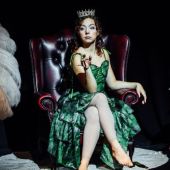
Billie, dazed-seeming, trying to fit in with her new British colleagues, is clearly junior and missing the references. She can’t even crack the code that means her ingenious fancy-dress (“Blessing” and the shades meaning disguise, tries too hard). Alternately vulnerable and angry in Jazz Jenkins’ hands, you see Billie shrink, take refuge, take ket accidentally when offered by her colleague Ayesha in error for coke (really?) and zone out. It’s a fine core performance as only through her interactions do we see the trouble. But it’s not her corporate colleagues who offer help, but two women, real blessings, who reach out. And one gets to the truth.
The rest of the cast multi-role. Ayesha Griffiths’ Noe starts with phoning: “A 5 out of 10 and that’s being generous…. Actually…a 4 after he started speaking.” Confiding spectacularly intimate details Noe’s “pathetic” still desperate for sex though she confides accidentally to April Hope Miller’s Lara who thinks she’s talking to her. This is how the hilarity and permeable membranes of cubicle walls both betray and welcome trust. So two women bond passing phones across under cubicle divides. A meet-cute with a difference.
Griffiths is a bravura performer, and her roles reflect it – as quickly sympathetic Noe later on (to Billie) as hers and Lara’s friendship blossoms. As minted Essex hen raver Aisha she lights up with appealing sassiness, and isn’t “Miss Mocktail” for nothing. And as Alex, careless colleague with devil’s horns concealing drugs with a flick of regret (does she mean it?), there’s indifference flecked with humanity that might turn callous. Finally, Griffiths inhabits adventurous Layla, one of the illegally-crashing schoolgirls. Kate Crisp’s movement direction allows a few collective rave moments to flash past like a dream. Elsewhere rapid shifts zing with pinpoint clarity.
Hope Miller’s Phoebe is one of the wilder teens, and heedless work colleague Nat. But as maid of honour and social worker Irish Liv, Hope Miller radiates the moral centre of the play. Despite entering with an inflatable penis and wrecked. Taking no prisoners as people continually call on her to break up ugly incidents offstage or see to someone collapsing, Liv’s ordering the pecks never ends. When she lays out someone she quips the bouncer owes her a favour and you get more than a whiff of Nessa. Both relied on, perhaps never able to move out of her work role, she’s crucial to Billy. And finds out what lies behind the “great hair” line that manager Dom starts.
Liv happens on Miya Ocego’s teen Flo which is piquant, since they’re related. What will responsible Liv do? It’s a sharp, sassy scene. As Jade, Ocego’s one of the heedless troupe of colleagues; but as bestie trans woman Tanya she leaps into prominence counselling Joanna Strafford’s querulous Heather, who’s just kissed a girl for the first time. And wants more, but thinks it’s wrong, or perhaps nothing. It’s a heartwarming coming-out scene with Strafford’s character not sure who she is.” And Ocego delivers the blissful line: “Oh babe, I feel like you’re turning into a butterfly or something. A beautiful gay butterfly.“ There’s so many great lines in this scene that Tanya needs to get her pen out to write them down. It’s when Liv appears and wields sorting-out lines after saying Tanya’s like Britney Spears: “Right ladies. Some fucker just told the bride she looks like a fat Claudia Winkelman so…”
As schoolgirl Maya and party-mode colleague Jules Strafford’s part of a pack. But as Liv’s hen friend El, a woman slowly falling apart, desperate for approval, she continually shuttles back and forth: vomming and needing Griffiths’ Aisha; yet somehow even doing the same for Liv’s self-image.
Liv, drunk and liable to use fists manages to sort two lives and the reveal comes with what’s happened to Billie. Hope Miller’s play superbly plays off intricate, inter-generational jokes – the hens love Abba, the teens think it so last century. And the hens’ ring-tones are so sadly millennial. There’s great set-pieces as the hens have to turn into a conga cow; and dissolves and barriers the cubicles denote whirl with dizzying combos. There’s an echo of the dramatic conceit of Sam Grabiner’s brilliant 2024 Soho debut Boys on the Verge of Tears: a play with far more characters set in a men’s toilet. And Italian company Teatro dei Gordi’s more unisex and mostly silent Pandora at the Coronet in 2025. Flush though is more intimate, more relatable, as the characters recur with three groups, two new friends and Billie’s semi-detachment.
Desolation, healing, trauma, joy, betrayal, vomming, sex and sexuality and new bonds shimmer through Flush like a permeable membrane. Perhaps even more might have been done with the cubicles, but the narrative truth is what matters, and the intersectional metaphors, incredibly sharp detailing with sheer exuberance – and quite a bit of flushing – mark Flush out as timely, timeless and as real as a selfie you might wish you’d never taken when you look again. You want more, perhaps even greater depth. Certainly Hope Miller’s next play will be an event. 80 minutes blink by, but you won’t miss it. Stunning.
Movement Director Kate Crisp, Stage Manager on Book Lydia Wainwright, Associate Designer Rachel Esra, Artwork Photographer Jake Bush, Visual artist Doug Kerr. Co-Producers Launch Box Productions, Kit Bromovsky.